

Most founders misunderstand what a design studio actually does. They imagine a room full of creatives sketching interfaces and arguing over gradients. Reality? A high-performing design studio operates as a strategic system. One that transforms ambiguity into clarity, aligns design decisions with business outcomes, and accelerates product velocity through structured workflows. The difference between a studio and a freelancer isn't team size. It's depth of process, pattern recognition across products, and an obsession with systems over one-off screens.
Why Design Studios Solve the Scale Problem
Startups face a unique constraint: they need product quality that signals credibility to investors and users, but they lack the resources for sprawling in-house teams. A design studio fills this gap by offering specialized expertise without the overhead.
The core value proposition breaks down into three components:
- Speed through systems - Studios develop repeatable frameworks that eliminate decision paralysis
- Cross-functional fluency - The best studios speak both design and development, reducing friction
- Pattern libraries from previous work - Experience across products builds intuition for what converts
Traditional agencies often operate project-to-project, optimizing for billable hours rather than outcomes. A product-focused design studio inverts this model. Every engagement builds on institutional knowledge, creating compounding returns for both the studio and its clients.
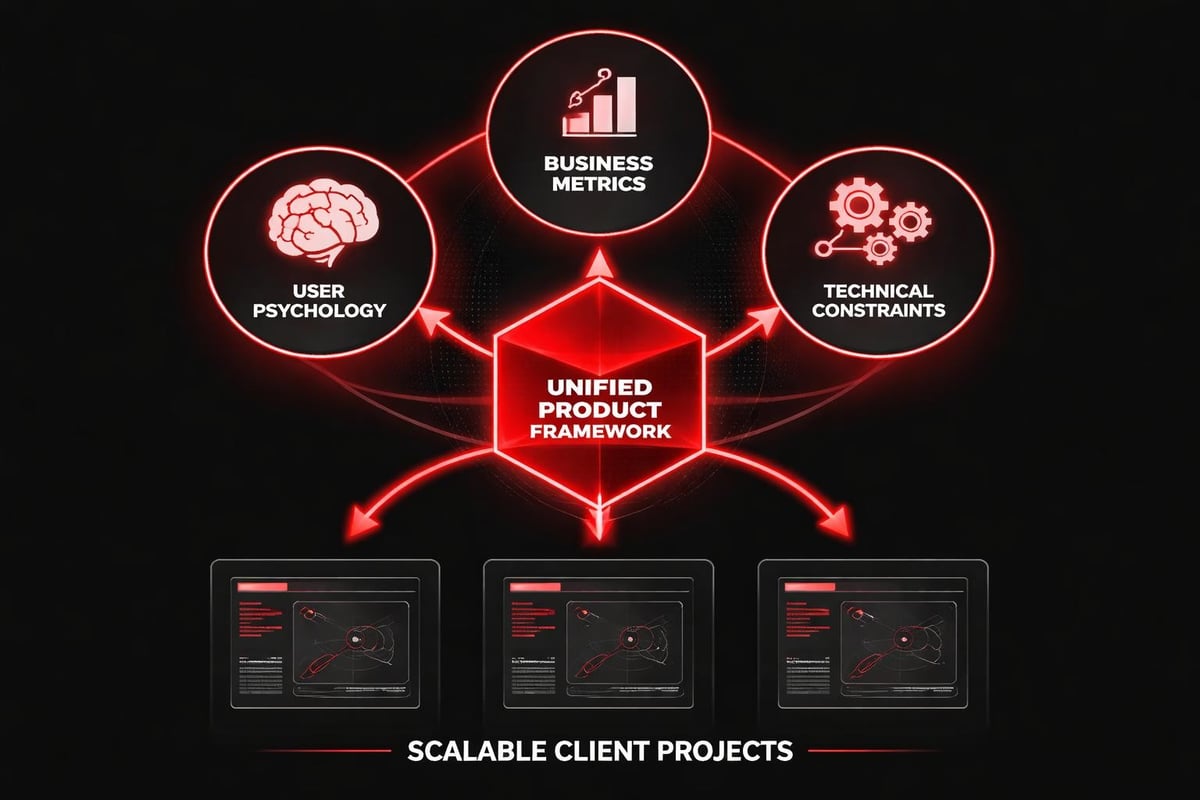
Research on design studio collaboration reveals that shared creative practices accelerate innovation. When teams establish common language and critique methods, iteration cycles compress. This matters most during the critical 0-to-1 phase when startups are validating product-market fit through design.
The Psychology of Studio Process
Design isn't decoration. It's applied cognitive science. Every interface decision either reduces cognitive load or increases it. A design studio worth its retainer understands this at a neurological level.
Consider navigation architecture. Users don't read menus-they scan for pattern matches. This means hierarchy matters more than creativity. A studio trained in information architecture will test different organizational models against user mental models, not personal preference.
| Design Decision | Cognitive Impact | Studio Approach |
|---|---|---|
| Visual hierarchy | Reduces scan time by 43% | Test contrast ratios against accessibility standards |
| Micro-interactions | Increases perceived speed | Design state changes that confirm user actions |
| White space | Improves comprehension by 20% | Calculate rhythm through 8px grid systems |
Psychology drives conversion. Understanding why users behave certain ways allows studios to design with intention rather than intuition. This is where collaborative studio cultures create advantage-cross-pollination of insights across different product domains.
AI-Accelerated Studio Workflows
Artificial intelligence doesn't replace design thinking. It eliminates the tedious parts so designers can focus on strategy and refinement. A modern design studio leverages AI across three workflow layers.
Layer one: Research compression. Instead of spending days analyzing competitor interfaces, AI vision models can process hundreds of reference sites in minutes, extracting patterns in layout structure, component usage, and visual hierarchy. This doesn't tell you what to design-it maps the competitive landscape faster.
Layer two: Iteration velocity. Generative tools allow studios to explore 10x more layout variations in the same timeframe. The human designer still makes the final call, but AI expands the solution space. For startups operating on tight timelines, this compression is transformative.
Layer three: Consistency enforcement. Design systems require vigilance. AI can audit component libraries, flag accessibility violations, and suggest standardizations that would take junior designers weeks to identify manually.
The design studio methodology traditionally involves collaborative sketching sessions. AI augments this by generating baseline variations that teams can then refine. Instead of starting from blank artboards, studios begin from AI-generated options that satisfy technical constraints.
Real Application: Conversion-Focused Product Pages
Let's examine how a design studio approaches a startup's product page redesign. The problem: 2.3% conversion rate, high bounce rate, unclear value proposition.
- Audit the cognitive flow - Map where users lose interest through scroll depth and heatmaps
- Isolate the friction points - Identify whether the issue is clarity, credibility, or call-to-action placement
- Design variants around hypotheses - Create three versions testing different value prop structures
- Implement with performance constraints - Ensure each variant loads under 2 seconds on mobile
- Measure against baseline - Run statistical significance tests on conversion lift
A skilled design studio doesn't just make things look better. They apply systematic thinking to isolate variables and measure outcomes. This is why startups see measurable ROI from product design partners rather than purely aesthetic refreshes.
AI enters this workflow during step three. Instead of manually creating every variant, the studio uses AI to generate structural alternatives while maintaining brand consistency. The designer's role shifts from pixel-pushing to strategic curation.
Studio Thinking: Systems Over Screens
The amateur designer optimizes individual screens. The studio designer architects entire systems. This mindset shift separates tactical execution from strategic product work.
What does systems thinking look like in practice?
- Component libraries that enforce consistency - Every button, input, and card follows the same visual logic
- Responsive behaviors defined at the system level - Layout rules cascade from breakpoint to breakpoint
- *Design tokens that connect brand to code** - Color, spacing, and typography values live in a single source of truth
- Documentation that enables team autonomy - Product managers can spec features without designer handholding
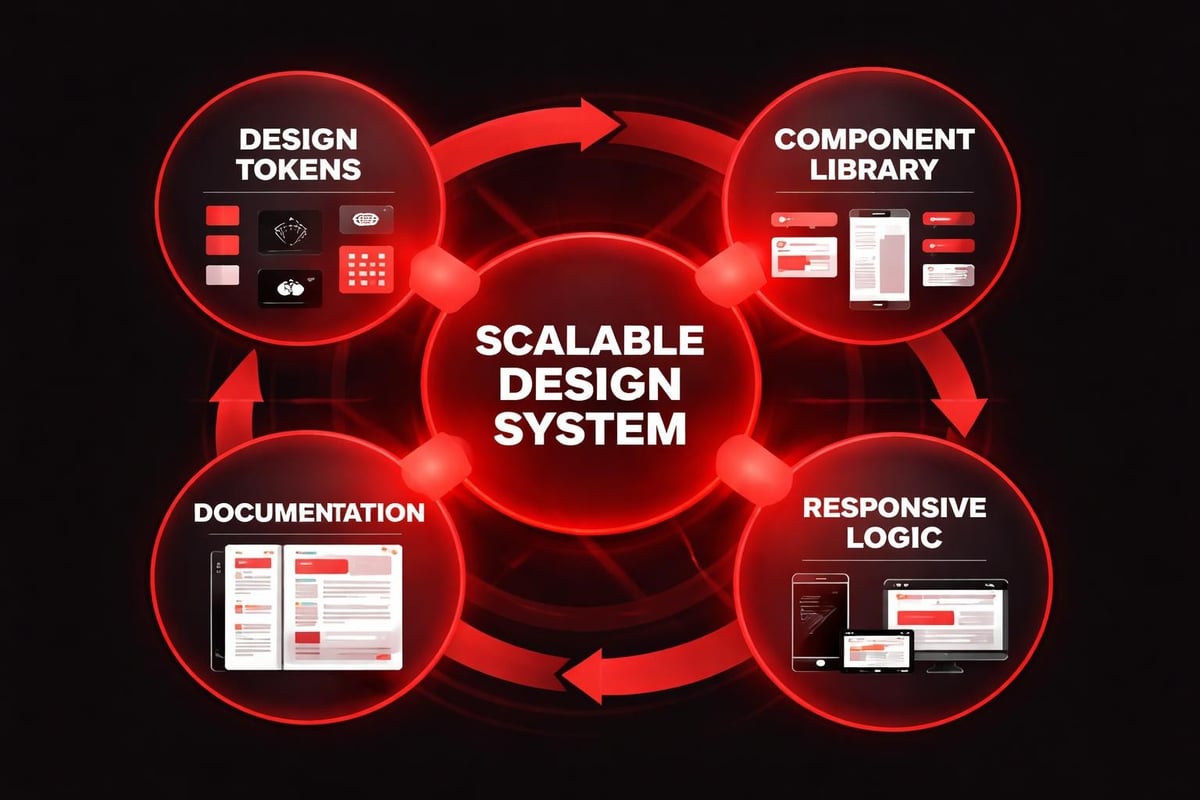
This systematic approach prevents design drift as products scale. When a startup adds new features, the design system provides guardrails that maintain coherence. Without this structure, products become Frankenstein collections of inconsistent patterns.
Studios that embrace systems-based design deliver compounding value. The first project establishes the foundation. Subsequent work builds on that infrastructure rather than reinventing interaction patterns.
Avoiding Common Studio Pitfalls
Even experienced studios fall into predictable traps. Understanding these failure modes helps both studio teams and clients recognize red flags early.
Trap one: Designing without constraints. Beautiful screens that can't be built are expensive art projects, not product design. Studios must work within technical reality-especially when partnering with lean engineering teams.
Trap two: Following trends over strategy. Every year brings new visual fashions. Brutalism, glassmorphism, maximalism. A studio chasing trends creates work that looks dated in six months. Timeless design comes from understanding user psychology, not Dribbble's trending page.
The team at Creative Bloq outlines common mistakes in design studio environments, including poor client communication and misaligned expectations. These human factors often derail projects faster than technical challenges.
Trap three: Ignoring performance. A stunning animation that tanks page load time hurts conversion more than it helps. Studios must balance visual ambition with technical performance, especially for high-performance websites where every millisecond impacts business metrics.
Workflow Optimization for Studio Operations
Internal studio efficiency directly impacts client outcomes. A chaotic studio produces chaotic work. Structure creates space for creativity rather than constraining it.
Five operational principles that separate high-output studios from the rest:
- Version control for design files - Abstract, Figma, or Git-based workflows prevent the nightmare of "final_final_v3_revised.fig"
- Async design reviews - Not every critique requires a meeting; Loom recordings and Figma comments scale better
- Client education frameworks - Teaching clients design thinking reduces revision cycles and builds trust
- Milestone-based delivery - Ship iteratively rather than waiting for perfection
- Retrospectives after each sprint - Capture what worked and what didn't while context is fresh
Research on UX design studio workflows emphasizes the importance of maintaining consistent processes even as projects vary. Standardized workflows reduce cognitive overhead, allowing teams to focus energy on creative problem-solving rather than process reinvention.
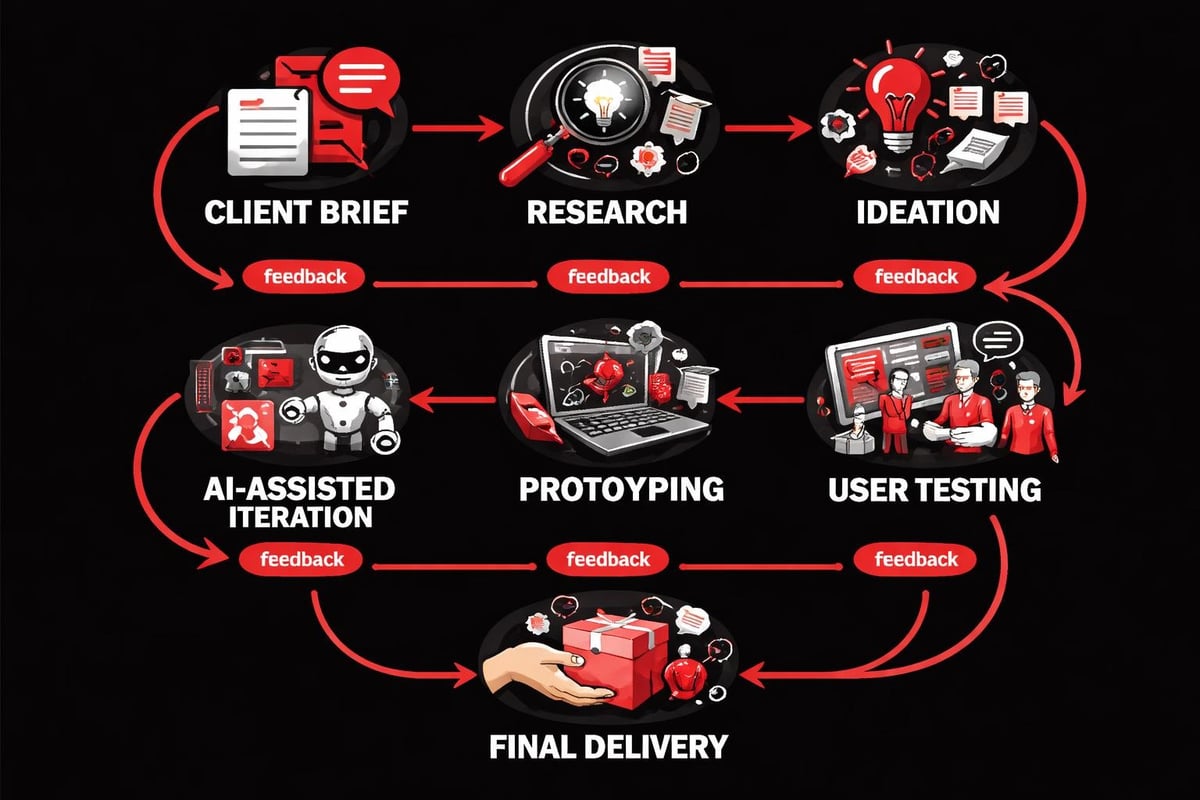
Modern studios increasingly adopt AI-assisted workflows not as replacement for human judgment, but as multipliers for efficiency. Automated component generation, intelligent layout suggestions, and rapid prototyping tools compress timelines without sacrificing quality.
| Workflow Stage | Traditional Time | AI-Assisted Time | Quality Impact |
|---|---|---|---|
| Competitive research | 2-3 days | 4-6 hours | Broader coverage |
| Low-fidelity mockups | 1 week | 2-3 days | More variations tested |
| Component building | 3-4 days | 1-2 days | Increased consistency |
| Accessibility audit | 2 days | 4-5 hours | More thorough coverage |
The Studio Partnership Model
The best client-studio relationships operate as partnerships, not vendor arrangements. This distinction shapes everything from communication cadence to decision-making authority.
What partnership looks like in practice:
- Embedded studio designers join client standups - Integration beats isolation every time
- Shared OKRs tied to business metrics - Design success measured in conversion lift, not Behance likes
- Collaborative roadmapping - Studios contribute strategic thinking, not just execution
- Transparent process - Clients see work in progress, not just polished presentations
Startups benefit most from studios that act as extended product teams rather than external contractors. This requires studios to deeply understand the business context-competitive positioning, customer segments, growth stage, and technical constraints.
The challenge: balancing multiple client relationships while maintaining this level of integration. Successful studios solve this through clear capacity planning and selective client onboarding. Not every project fits every studio.
Measuring Studio Impact
Founders need concrete metrics to justify design investment. Vanity metrics (likes, awards, aesthetics) don't correlate with business outcomes. Smart studios track what matters.
Primary metrics for product design impact:
- Conversion rate changes - The most direct measure of design effectiveness
- Time-to-value reduction - How quickly users achieve their first success
- Feature adoption rates - Whether new capabilities actually get used
- Support ticket reduction - Good design eliminates confusion before it reaches support
- Engineering velocity - Whether design systems accelerate or slow development
Secondary indicators include session duration, return visitor rates, and qualitative user feedback. But these lag metrics should support, not replace, hard conversion data.
Studios that tie their work to measurable outcomes build stronger client relationships. When a redesign demonstrably increases revenue by 34%, renewing the engagement becomes obvious. When impact is vague, relationships become transactional.
Evolution of Studio Capabilities in 2026
The design studio landscape shifted dramatically between 2023 and 2026. Studios that adapted thrive. Those that clung to 2018 workflows struggle.
Key capability shifts:
- From static deliverables to living systems - Figma files matter less than functional component libraries
- From waterfall to continuous iteration - Launch and refine beats months of pre-launch perfection
- From generalist to specialized - Studios pick verticals (SaaS, fintech, healthcare) rather than claiming expertise in everything
- From offshore to asynchronous - Geographic distribution matters less than timezone-friendly processes
AI capabilities expanded beyond simple automation. Studios now use AI for qualitative user research synthesis, accessibility recommendations, and even A/B test variant generation. The designer's role elevated from executor to strategist and curator.
Platforms like Framer merged design and development, allowing studios to ship production code directly from design tools. This eliminated entire handoff steps that traditionally slowed projects and introduced inconsistencies.
The most forward-thinking studios built proprietary design frameworks-systematic approaches to common product challenges. Rather than reinventing navigation patterns for every SaaS product, they deploy battle-tested solutions and focus creative energy on differentiation.
Integration With Development Teams
Design-development collaboration determines project success more than individual skill. A brilliant design poorly implemented delivers worse outcomes than a decent design executed flawlessly.
Studios achieve development integration through:
- Design tokens from day one - Shared language for colors, spacing, typography
- Component-based thinking - Designers and developers reference the same building blocks
- Realistic prototype fidelity - Interactive prototypes that demonstrate actual behavior, not just visual design
- Performance budgets baked into design - Image sizes, animation complexity, and load targets defined early
- Collaborative QA processes - Designers review staging environments, not just design files
Research from CHI conferences on design studio processes demonstrates that cross-functional participation improves both design quality and implementation accuracy. When engineers contribute to design thinking sessions, they spot technical constraints early. When designers understand code limitations, they propose feasible solutions.
Modern studios treat development constraints as creative parameters rather than frustrating limitations. The best designs often emerge from working within boundaries rather than ignoring them.
The Embark Studio Approach
What separates a commodity design service from a strategic partner? Depth of thinking. Process rigor. Obsession with outcomes over outputs.
At its core, studio work should create leverage for founding teams. Every hour invested in design should return multiples in reduced confusion, increased conversion, and accelerated decision-making. This requires studios to think in systems-scalable frameworks that compound in value rather than depreciating after launch.
The workflow matters as much as the deliverable. Studios that ship fast without sacrificing quality don't skip steps-they've systemized the repeatable parts so energy flows toward strategic decisions. AI amplifies this approach, handling rote tasks while humans focus on judgment calls that determine product success.
Design isn't about making things pretty. It's about creating clarity in complexity, reducing friction in user flows, and building trust through every interaction. Studios that understand this produce work that drives measurable growth rather than collecting awards.
Modern product design demands systematic thinking, technical fluency, and relentless focus on conversion outcomes. The design studio model delivers this through specialized expertise, battle-tested frameworks, and AI-accelerated workflows that compress timelines without compromising quality. If you're building a startup that needs velocity without sacrificing craft, explore how Embark Studio™ approaches product design as a strategic growth partner. We help founding teams ship faster, convert better, and scale with confidence.
Get articles like this in your inbox
Practical design and growth insights for founders. No spam, unsubscribe anytime.


