

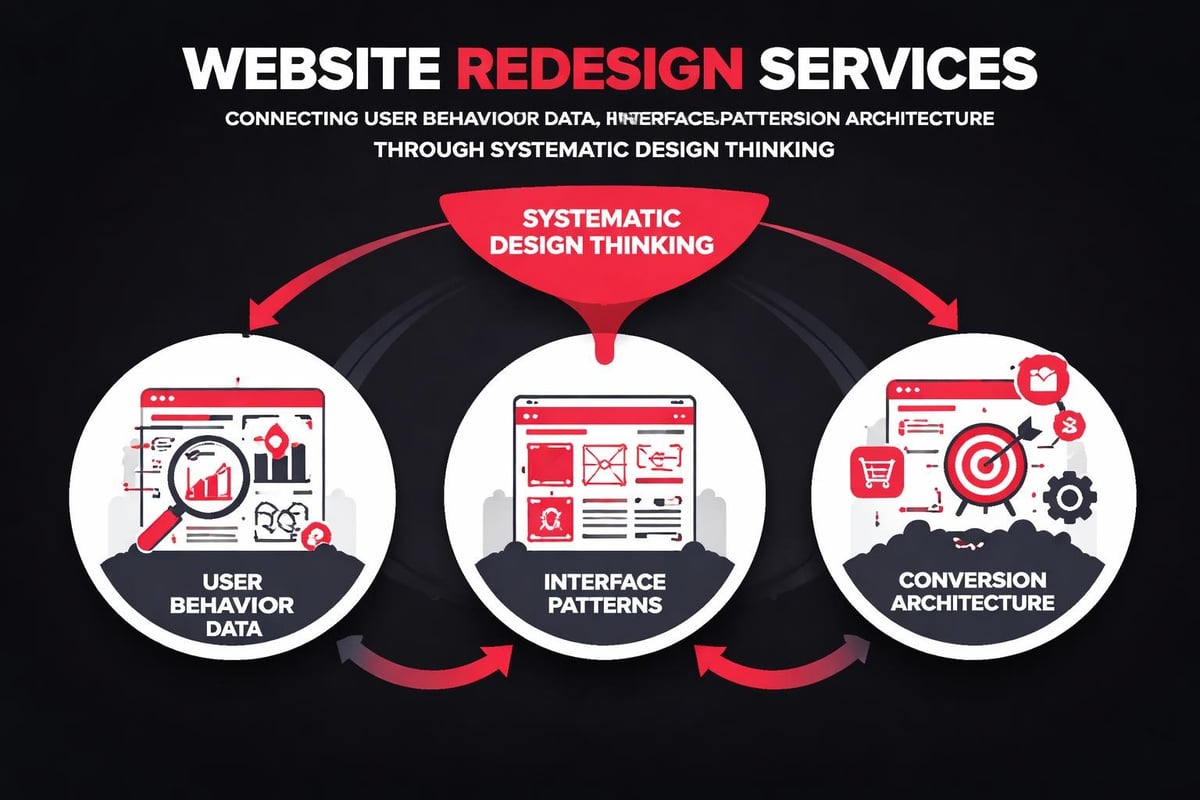
Most teams approach website redesign services the wrong way. They focus on visual updates, surface-level modernization, or simply chasing trends. The result? A slightly prettier website that solves none of the underlying performance problems. Real redesign work starts with understanding why your current experience fails, what behavior you're trying to shape, and how design systems scale those insights across every touchpoint.
The Problem with Traditional Redesign Thinking
Traditional website redesign services operate on a flawed premise: that visual refresh equals business impact.
They deliver new colors, fonts, and layouts without addressing conversion architecture, page hierarchy, or behavioral flow. The website looks different, but the user journey remains broken. Bounce rates don't improve. Sign-ups don't increase. The design system doesn't exist, so every new page becomes a custom problem.
This happens because most agencies separate strategy from execution. One team audits, another designs, a third builds. Each handoff dilutes the original insight. By the time the site launches, the connection between user psychology and interface logic has disappeared entirely.
The deeper issue is structural, not aesthetic.
Modern website redesign services must integrate research, design, and engineering into a unified workflow. When user data analysis reveals friction points, design decisions should immediately reflect those insights. When conversion metrics shift, the system adapts without requiring a complete overhaul.
Why Design Systems Drive Successful Redesigns
The difference between a successful redesign and a wasted investment comes down to systematic thinking.
A design system isn't just a component library or style guide. It's a set of principles that govern every interface decision. It defines how information hierarchies work, how interactive elements behave, and how content structures scale across devices and contexts. Building scalable design systems means every future addition strengthens the whole rather than fragmenting it.
Here's how system-first redesigns differ from traditional approaches:
| Traditional Redesign | System-First Redesign |
|---|---|
| Page-by-page updates | Component-level architecture |
| Custom solutions for each template | Reusable patterns with clear logic |
| Designer-dependent decisions | Rule-based design tokens |
| Manual updates across pages | Cascade changes through the system |
| Inconsistent user experience | Predictable interaction patterns |
When website redesign services prioritize systems over screens, maintenance costs drop dramatically. New pages don't require custom design work because the system already defines how content types behave. A/B testing becomes faster because variables are isolated within components. Team velocity increases because design and development workflows align.
Building for Behavior, Not Beauty
Great redesigns shape user behavior through structure, not decoration.
Every interface element should serve a psychological function. Navigation should reduce cognitive load. Call-to-action placement should align with scanning patterns. Content rhythm should guide attention toward conversion moments. This requires understanding how users actually process information, not how designers think they should.
Research on emotional design in web experiences shows that users respond to perceived depth, clarity, and intentionality. They trust interfaces that feel coherent. They abandon experiences that seem arbitrary or inconsistent. The visual layer matters, but only when it reinforces behavioral architecture.
- Map the actual user journey through analytics and session recordings
- Identify friction points where drop-off exceeds acceptable thresholds
- Design intervention points that reduce cognitive load or clarify next steps
- Test behavioral impact before committing to full implementation
- Iterate based on conversion data, not subjective preference
This process-driven approach eliminates guesswork. When website redesign services build on evidence rather than trends, every design decision connects directly to business outcomes.
How AI Accelerates Redesign Workflows Without Replacing Creativity
AI doesn't design websites. It removes the repetitive friction that slows human decision-making.
Modern redesign workflows integrate AI at specific leverage points: generating layout variations based on established patterns, optimizing image assets for performance, suggesting content structures based on semantic analysis, and automating responsive breakpoint adjustments. AI-assisted design workflows compress iteration cycles from days to hours.
Where AI adds genuine value:
- Component variant generation: Feed a base component into an AI tool with specific constraints, generate dozens of spacing and proportion variations instantly
- Content structure optimization: Analyze competitor pages for semantic patterns, suggest heading hierarchies that match user search intent
- Performance prediction: Simulate page speed impact before committing to asset-heavy designs
- Accessibility auditing: Automatically flag contrast ratios, focus states, and ARIA label gaps
The creative work remains entirely human. AI doesn't understand brand strategy, can't interpret nuanced user research, and lacks the judgment to prioritize competing conversion goals. It accelerates the mechanical parts of design so teams can focus on psychological insight and strategic decisions.
The Studio Thinking Difference
Website redesign services that operate like studios rather than production lines produce fundamentally different outcomes.
Studios think in systems. They establish design principles first, then apply them consistently. They prototype with real content, not lorem ipsum. They measure behavioral impact, not just aesthetic preference. Case studies across industries demonstrate that systematic approaches reduce project timelines while improving long-term performance metrics.
At Embark Studio™, we structure redesigns around three core pillars: clarity in information architecture, depth in interactive details, and rhythm in content flow. These aren't vague aspirations. They're measurable principles that inform every component decision, every spacing choice, every micro-interaction.
The Conversion-Focused Redesign Framework
Performance metrics should drive every redesign decision, but most teams measure the wrong things.
Page views don't matter if users bounce. Session duration is meaningless if it doesn't correlate with sign-ups. Even conversion rate can mislead when the denominator includes irrelevant traffic. Smart redesign processes focus on meaningful metrics tied to actual business outcomes: qualified lead generation, feature adoption, trial-to-paid conversion.
The framework starts with baseline measurement:
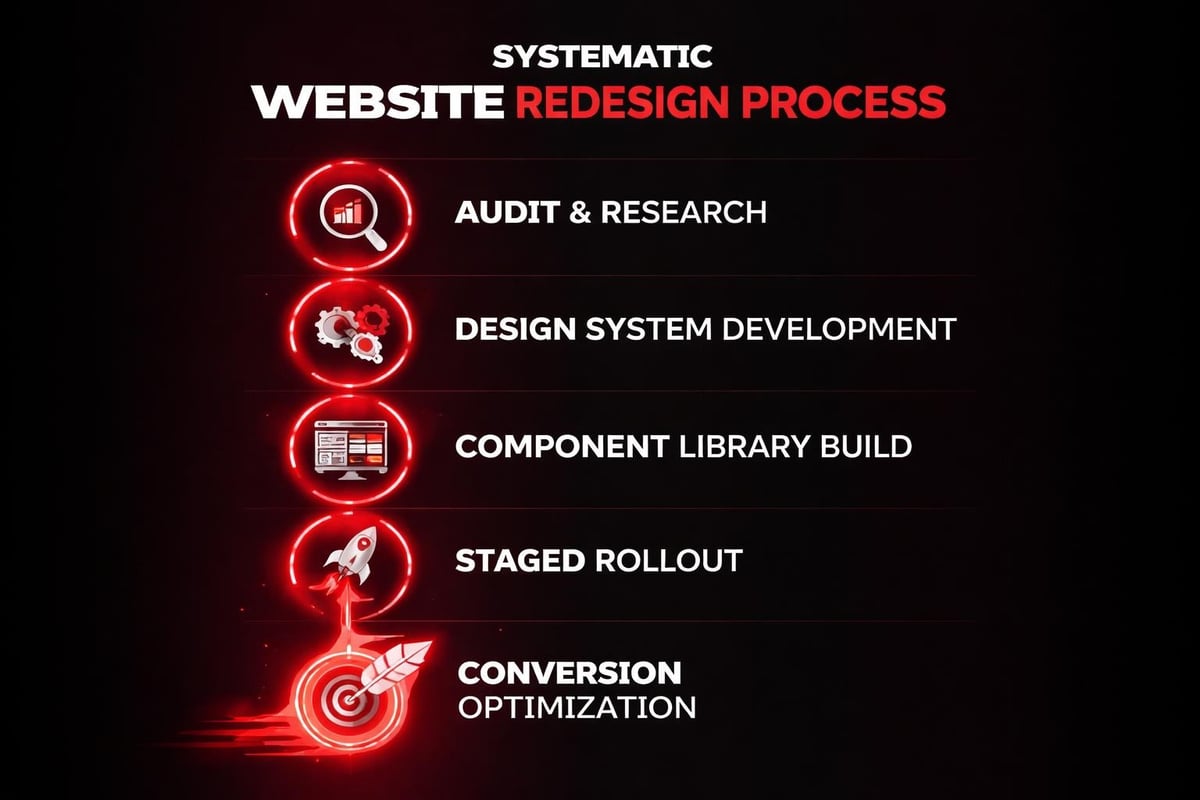
- Document current conversion rates across key funnels
- Identify the biggest drop-off points in each flow
- Hypothesize why users abandon at those specific moments
- Design targeted interventions that address those friction points
- Test changes in isolation to measure actual impact
- Roll out winning variations systematically across the site
This approach requires discipline. It means resisting the urge to redesign everything at once. It means accepting that some beautiful ideas won't improve conversion. It means treating design as a scientific process, not an artistic expression.
Real Implementation: From Audit to Impact
Consider a typical SaaS homepage redesign.
The audit reveals that 60% of visitors bounce within eight seconds. Session recordings show users scrolling past the hero section without engaging. The value proposition reads like every other competitor. The call-to-action blends into the background. The feature section uses abstract language instead of outcome-focused benefits.
The systematic fix:
| Problem Area | Design Intervention | Expected Impact |
|---|---|---|
| Hero clarity | Replace generic tagline with specific outcome statement | Reduce 8-second bounce rate |
| Visual hierarchy | Increase CTA contrast ratio, add directional cues | Improve click-through to trial |
| Feature communication | Show product in context, lead with customer results | Increase time-on-page, scroll depth |
| Trust signals | Add specific metrics, customer logos, recent activity | Reduce hesitation at sign-up |
Each intervention targets a specific behavioral barrier. Each change can be tested independently. Each improvement compounds with the others. This is how conversion-focused design systems generate measurable ROI.
Mobile-First Isn't Optional Anymore
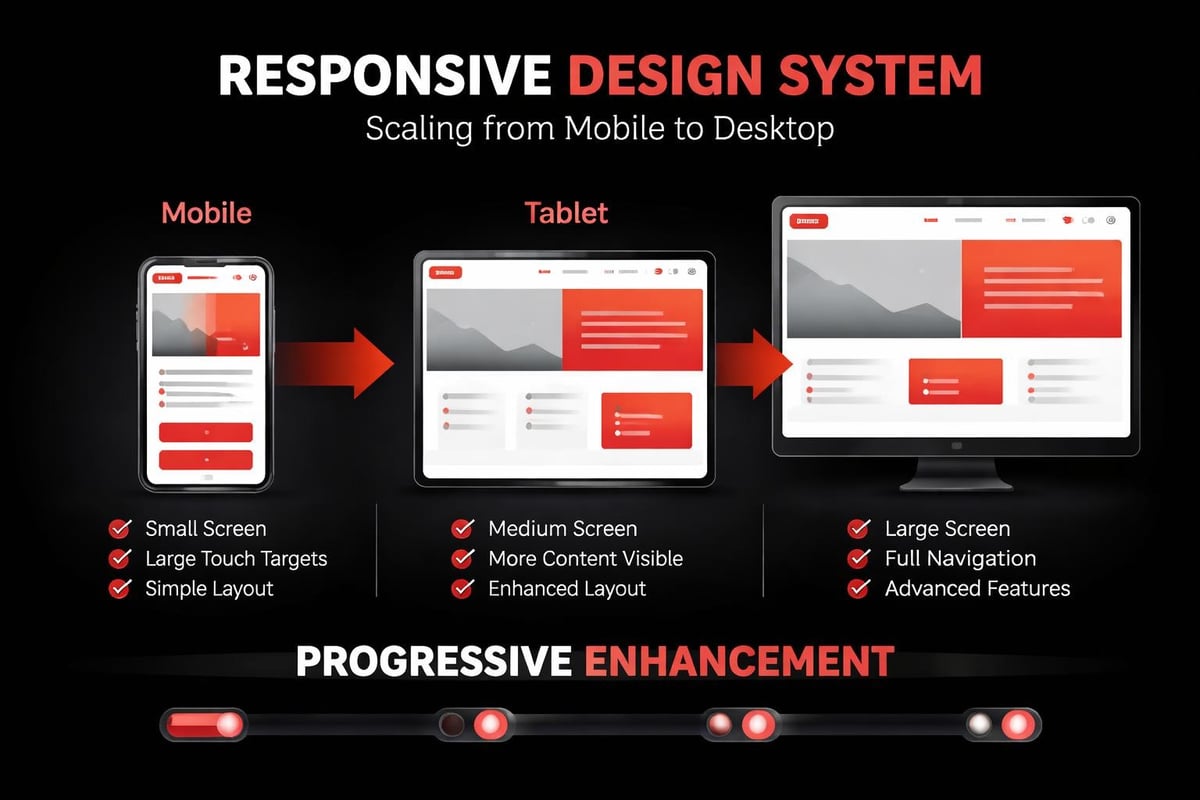
Most website traffic comes from mobile devices, yet most redesigns still start with desktop layouts.
This creates fundamental problems. Desktop-first design leads to cramped mobile experiences where navigation collapses awkwardly, content hierarchy breaks down, and interactive elements become too small to use comfortably. By the time teams adapt the design for mobile, they're working backward, trying to fit a complex structure into a constrained space.
Mobile-first website redesign services reverse this:
Start with the smallest screen. Define content priority when space is limited. Design touch targets for actual finger sizes. Test scroll depth on real devices. Only then expand to larger breakpoints, adding complexity where space allows.
This forces better decisions at every level. If a feature doesn't work on mobile, it probably isn't essential. If content can't be understood in a narrow column, the writing needs clarity. If navigation requires multiple taps, the information architecture needs simplification.
The technical benefits compound quickly. Mobile-first CSS is smaller. Mobile-first images load faster. Mobile-first interactions feel more responsive. Page speed optimization becomes easier when the baseline is already lean.
Staging Rollouts Reduce Risk and Improve Results
Launching an entire redesigned website at once is the riskiest possible approach.
One bad assumption can tank conversion across the entire site. One overlooked edge case can break critical user flows. One untested interaction pattern can frustrate thousands of users simultaneously. Effective redesign processes use staged rollouts to validate assumptions before committing fully.
The Progressive Launch Strategy
- Start with low-traffic pages to test the design system in production
- Monitor performance metrics against existing baselines for at least two weeks
- Roll out to secondary conversion paths like feature pages or blog templates
- Validate that changes improve or maintain key engagement indicators
- Deploy to primary landing pages only after confirming system stability
- Keep rollback options available throughout the entire process
This approach treats redesigns like product launches, not one-time projects. It assumes you'll learn things in production that weren't visible in staging. It builds in feedback loops so those learnings can inform subsequent phases.
The psychological benefit is equally important. Teams feel less pressure when they know changes can be reverted. Stakeholders trust the process more when they see data validating each stage. Users experience fewer disruptions because problems get caught before they scale.
The Importance of Usability Testing Throughout the Process
Design reviews with internal teams catch some problems. Real user testing catches the rest.
Most website redesign services skip this step or leave it until the end. By then, fundamental structural issues are too expensive to fix. Navigation paradigms are set. Content hierarchies are finalized. Interactive patterns are built. Usability insights arrive too late to influence core decisions.
Continuous testing integration prevents this:
- Wireframe stage: Test information architecture with card sorting and tree testing
- Prototype stage: Validate interaction patterns with clickthrough prototypes
- Component stage: Confirm individual elements work as expected in isolation
- Integration stage: Test complete user flows across multiple templates
- Pre-launch stage: Run final validation with target audience segments
Each testing phase answers specific questions. Early tests confirm strategic direction. Later tests refine tactical execution. The goal isn't perfection. It's reducing the gap between designer intent and user reality.
Usability testing best practices emphasize recruiting participants who match your actual audience, not just convenient volunteers. A startup founder navigates differently than an enterprise buyer. A technical user expects different patterns than a first-time visitor. Test with people who represent your actual conversion funnel.
Integrating Brand Strategy Into Functional Design
Website redesign services often separate brand work from UX work. This creates disconnected experiences.
The visual identity feels like a shell applied to functional wireframes. The brand voice doesn't align with interaction patterns. The emotional tone conflicts with the behavioral architecture. Users sense the inconsistency even if they can't articulate it.
Integration starts with aligned principles:
| Brand Strategy | Design System Expression |
|---|---|
| Trustworthy, reliable | Predictable interaction patterns, clear feedback |
| Innovative, forward-thinking | Subtle motion design, progressive disclosure |
| Human-centered, approachable | Conversational microcopy, friendly error states |
| Efficient, results-driven | Minimal steps to conversion, performance-optimized |
Every brand attribute should translate into specific interface decisions. If your brand is "bold," that should manifest in high-contrast hierarchies and confident CTAs, not just large typography. If your brand is "thoughtful," that should appear in helpful tooltips and proactive error prevention, not just muted colors.
This requires collaboration between brand strategists and product designers from day one. Corporate brand identity work informs design system foundations. Design system constraints inform brand expression in digital contexts. Neither dictates the other. They evolve together.
Why Website Redesign Services Need Ongoing Optimization
Launch day is the beginning, not the end.
Even the most thoroughly researched redesign makes assumptions that reality will challenge. User behavior shifts. Business priorities evolve. Competitive landscapes change. A website that isn't continuously optimized becomes outdated within months, not years.
Modern website redesign services should include post-launch optimization as a core offering. This means regular performance audits, quarterly conversion analysis, ongoing A/B testing programs, and systematic improvements based on actual usage data. Ongoing design partnerships maintain momentum instead of letting sites stagnate between major overhauls.
The optimization cycle never stops:
- Monitor behavioral analytics and conversion funnels weekly
- Identify underperforming pages or flows monthly
- Develop hypotheses for improvement based on data patterns
- Test interventions in controlled experiments
- Roll out winning variations systematically
- Document learnings to inform broader design system evolution
This creates compound returns. Each small improvement builds on previous wins. The design system gets smarter over time. The team develops deeper intuition about what works for their specific audience. The website becomes a living asset that appreciates in value rather than depreciating.
Selecting the Right Website Redesign Services Partner
Not all redesign providers operate the same way.
Some focus on templates and quick turnarounds. Others specialize in enterprise complexity and lengthy timelines. Some treat design as a creative service. Others approach it as a technical discipline. The right partner depends on your specific needs, but certain qualities indicate systematic thinking over superficial execution.
Look for teams that:
- Ask about business metrics before discussing visual preferences
- Show examples of design systems, not just finished websites
- Explain their process in behavioral terms, not aesthetic language
- Reference specific research methodologies and testing frameworks
- Demonstrate post-launch optimization as standard practice
- Work in modern tools that support systematic workflows
Organizations sharing redesign best practices emphasize the importance of partner alignment on goals, timelines, and success metrics. The cheapest option rarely delivers the best value. The most expensive doesn't guarantee results. Find a partner whose process matches your organizational maturity and growth stage.
The Framer Advantage for Startup Redesigns
For startups and product companies, tool choice significantly impacts redesign outcomes.
Traditional website builders create maintenance overhead. Custom code requires ongoing developer resources. Enterprise CMSs demand extensive training. Framer represents a different approach: design-first tooling that produces production-ready code, enabling faster iteration without sacrificing quality. Understanding modern Framer workflows reveals why startups increasingly choose this path.
The benefits compound for teams that need velocity:
- Designers can build and deploy without engineering bottlenecks
- Component libraries sync automatically between design and production
- Performance optimization happens at the framework level
- Responsive behavior is defined visually, not through code
- Iteration cycles compress from weeks to days
This doesn't eliminate the need for systematic thinking. Tools enable workflows, but they don't create strategy. The discipline of defining design principles, mapping user psychology, and measuring behavioral impact remains entirely human work.
Building Redesigns That Scale With Your Product
Most website redesigns assume static product offerings. This fails quickly for growing companies.
Every new feature launch requires custom page design. Every product pivot means rebuilding sections. Every market expansion demands localized variations. Without systematic foundations, the website becomes a maintenance burden that consumes resources without driving growth.
Scalable redesigns anticipate evolution:
Design modular content structures that adapt to new product categories without requiring template redesigns. Build component systems that handle variable content lengths gracefully. Create style frameworks that support brand extensions without breaking visual coherence. Plan information architectures that accommodate growth in depth and breadth.
Effective website redesign guides emphasize thinking three to five years ahead. What will your product line look like? How many markets will you serve? What content types will you need to support? These questions shape system architecture in ways that protect long-term investment.
The practical implementation shows up in component flexibility. A well-designed feature card should work equally well for five features or fifty. A product page template should accommodate simple SaaS tools and complex enterprise platforms. Navigation systems should scale from six pages to sixty without requiring structural overhauls.
Website redesign services deliver lasting value when they prioritize systems over screens, behavior over aesthetics, and measurable outcomes over subjective preferences. The most successful redesigns integrate research, design, and optimization into continuous workflows that compound improvements over time. If you're building a product experience that needs to scale with your business, Embark Studio™ specializes in systematic redesigns that combine design thinking, modern tooling, and AI-assisted workflows to help startups move faster and convert better.
Get articles like this in your inbox
Practical design and growth insights for founders. No spam, unsubscribe anytime.


