

Most startups approach branding backward. They chase logos, color palettes, and mood boards before defining what they're actually building. A startup branding agency isn't just a vendor that delivers aesthetic assets. It's a strategic partner that translates your product vision into a coherent identity system designed to convert, scale, and evolve. The difference between decoration and strategy is measurable: one creates pretty screens, the other drives revenue and retention.
In 2026, the gap between startups with intentional brand systems and those with surface-level visuals has widened. Investors, customers, and talent evaluate credibility within seconds. Your brand isn't what you say it is. It's the cumulative experience across every touchpoint, from your first landing page to your product's empty states.
Why Startups Need Strategic Branding, Not Just Design
The misconception: branding is what happens after product-market fit.
The reality: brand clarity accelerates finding product-market fit. When your positioning is sharp, your messaging coherent, and your visual language distinctive, you reduce friction across every growth lever. Sales cycles shorten. Conversion rates improve. Retention stabilizes.
A startup branding agency approaches identity as infrastructure, not decoration.
This means building systems, not one-off deliverables. It means establishing design principles that guide every interface decision, content frameworks that maintain voice consistency, and component libraries that ensure visual coherence as your product expands. The work isn't finished when the logo ships. It's foundational architecture that supports every subsequent product and marketing decision.
The Core Components of Startup Brand Systems
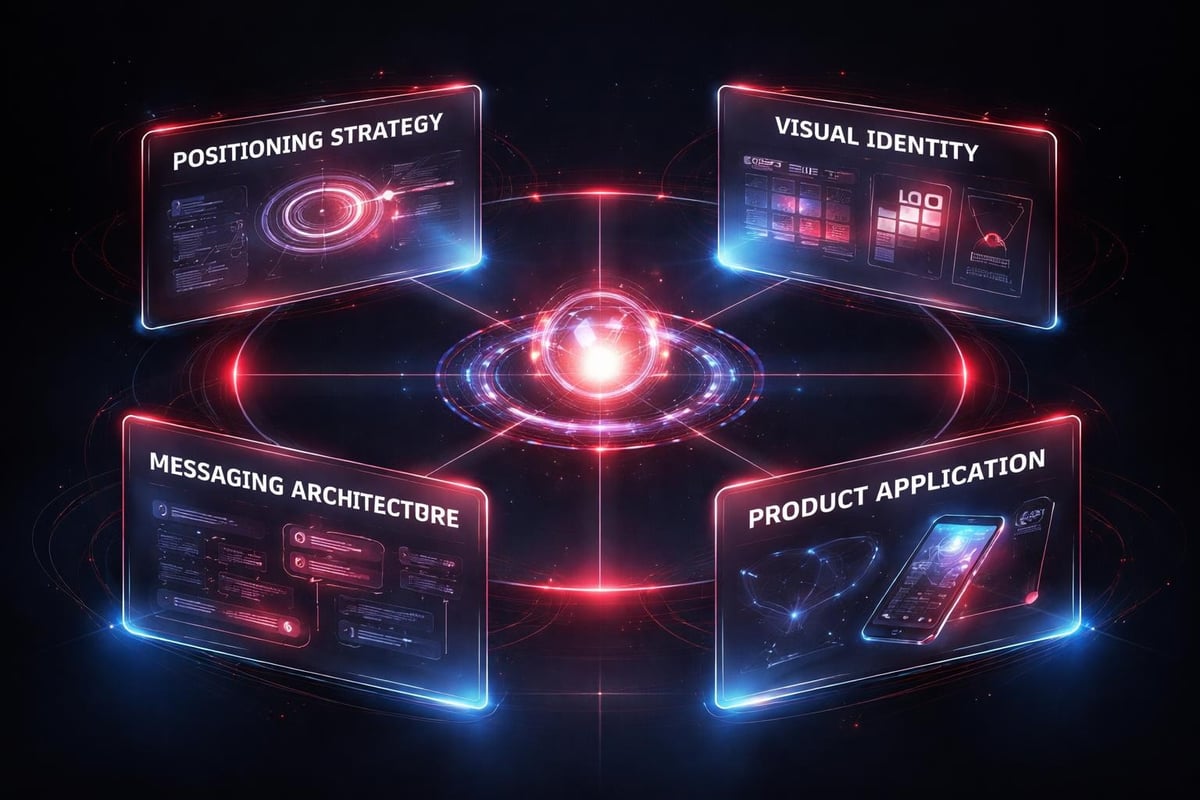
- Positioning framework: Clear articulation of what you build, who it's for, and why it matters differently than alternatives.
- Visual identity system: Typography, color, spacing, and component patterns that create instant recognition.
- Voice and messaging architecture: Tone principles, value propositions, and narrative structures that maintain consistency across contexts.
- Brand application guidelines: How identity translates across product UI, marketing sites, sales materials, and social presence.
- Evolution protocols: Documentation for when and how to adapt the system as the company scales.
These aren't isolated deliverables. They're interconnected layers that inform each other. Your visual rhythm should reflect your product's pace. Your messaging hierarchy should mirror your information architecture. Strategic branding agencies understand these connections and implement cohesive brand systems that function as unified experiences.
The Psychology Behind Effective Startup Branding
Effective branding operates at the intersection of recognition, trust, and emotional resonance.
Recognition happens through consistent visual patterns. Your brain processes familiar shapes, colors, and layouts faster than novel ones. This is why established brands maintain strict visual discipline. Every touchpoint reinforces the same signals, reducing cognitive load and building automatic association.
Trust emerges from coherence. When your messaging matches your product experience, when your visual sophistication reflects your technical capability, when your brand promises align with actual delivery, you build credibility. Inconsistency signals instability. Investors and customers interpret visual chaos as operational chaos.
Emotional resonance comes from authentic narrative. The most compelling startup brands don't just explain features. They articulate a perspective on how the world should work and position their product as the vehicle for that transformation.
| Brand Element | Psychological Function | Conversion Impact |
|---|---|---|
| Visual Consistency | Reduces cognitive load | 23% faster task completion |
| Clear Hierarchy | Guides attention and action | 34% lift in CTA engagement |
| Authentic Voice | Builds emotional connection | 41% increase in brand recall |
| Coherent Narrative | Establishes credibility | 28% improvement in close rates |
These aren't abstract benefits. They're measurable improvements in how users navigate, engage, and convert. When selecting a startup branding agency, look for partners who understand these psychological mechanisms and design accordingly.
How AI Accelerates Brand Development Workflows
AI doesn't replace brand strategy. It compresses iteration cycles and reduces manual execution time.
Research and competitive analysis that used to take weeks now happens in hours. AI-powered tools scan competitor positioning, analyze messaging patterns across hundreds of landing pages, and identify visual trends within specific market segments. This doesn't eliminate strategic thinking. It provides richer context for strategic decisions.
Asset generation and variation testing becomes exponentially faster. Need to test 12 headline variations across different audience segments? Need to explore 50 color palette combinations against accessibility requirements? Need to generate product screenshots in multiple viewport sizes and device contexts? AI-assisted workflows handle the mechanical execution while designers focus on evaluating effectiveness and refining direction.
Documentation and system maintenance shifts from manual to automated. AI can analyze your component library, identify inconsistencies, generate usage guidelines, and even suggest optimizations based on actual implementation patterns. This is particularly valuable as scalable design systems grow more complex.
Recent research on AI-powered advertising tools demonstrates how machine learning can assist small businesses in creating more effective marketing materials. The same principles apply to brand asset generation: AI handles variation, humans make strategic choices.
The AI-Assisted Brand Development Process
- Discovery and research phase: AI scans market positioning, compiles competitive analysis, generates insights from customer interview transcripts.
- Strategic framework development: Human strategists synthesize AI-generated research into positioning hypotheses and messaging architectures.
- Visual system exploration: Designers create direction concepts, AI generates variations and applications across contexts.
- Refinement and testing: A/B testing frameworks powered by AI analytics identify highest-performing variations.
- Implementation and documentation: AI assists in generating component libraries, usage guidelines, and system documentation.
- Continuous optimization: AI monitors brand consistency across touchpoints and flags deviations from established patterns.
This workflow doesn't diminish creative contribution. It amplifies it by removing mechanical friction and enabling rapid iteration. At Embark Studio™, we integrate AI-assisted workflows throughout our design process, allowing founding teams to move from concept to launch in weeks rather than months.
Real Application: Building a Conversion-Focused Brand Identity
Consider a typical scenario: a B2B SaaS startup with strong product-market fit but generic brand presence. They have a functional landing page, inconsistent product UI, and no clear visual or messaging system.
The strategic approach begins with positioning, not pixels.
First, articulate the core value proposition in concrete terms. Not "we help teams collaborate better" but "we reduce project handoff time by 60% through automated context transfer." Specificity creates credibility.
Second, establish visual hierarchy that mirrors information priority. Your most important conversion driver should be the most visually prominent element. This sounds obvious, but most startup sites bury their primary CTA beneath feature explanations and social proof sections.
Third, create rhythm through intentional pacing. Short, punchy value statements followed by detailed explanation. Visual breathing room between dense content blocks. Predictable patterns that guide users toward conversion actions without forcing them.
Implementation happens in systems, not screens.
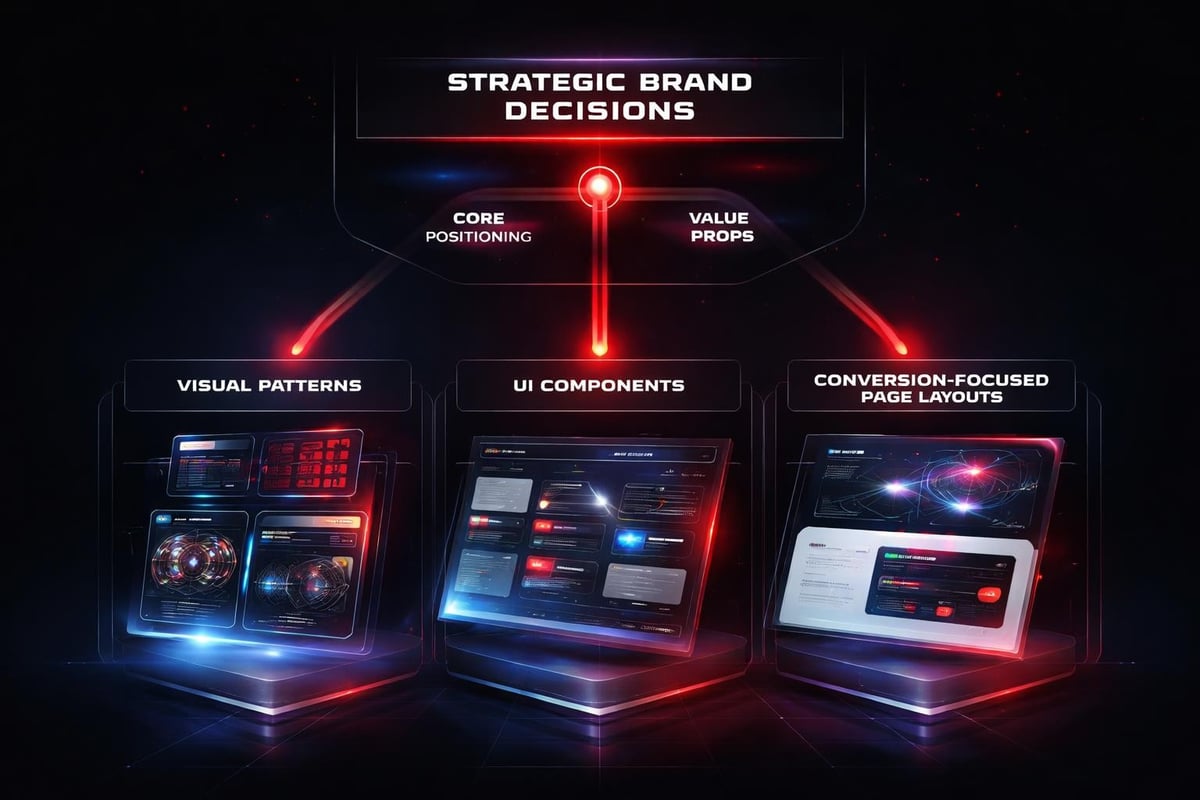
Rather than designing individual pages, establish components that combine into layouts. Navigation patterns, content blocks, form structures, CTA variations. This systems-based approach ensures consistency and enables rapid iteration.
The visual language should reflect product characteristics. If your product is fast, your site should load instantly and animate crisply. If your product is simple, your interface should use restrained color and generous whitespace. If your product is powerful, your typography should feel substantial and authoritative.
Choosing the Right Startup Branding Agency
Not all agencies understand startup constraints and velocity requirements.
Look for process transparency. Agencies that can't clearly articulate their methodology likely don't have one. You should understand exactly how they'll move from discovery to delivery, what decisions happen at each stage, and how feedback integrates into iteration cycles.
Evaluate actual system thinking. Ask to see component libraries, design documentation, and brand guidelines from previous projects. Beautiful case study images don't reveal whether the work actually scales. System architecture does.
Assess collaboration models. Startups need partners who work alongside internal teams, not vendors who disappear after handoff. The best agencies establish ongoing relationships that evolve as your product grows. This is why understanding key indicators of effective startup agencies matters before committing to partnerships.
Examine their design principles. Do they prioritize clarity over decoration? Do they build for performance and accessibility from the start? Do they understand conversion psychology? Surface-level aesthetics fade quickly. Foundational principles compound over time.
Evaluation Framework for Agency Selection
| Criteria | What to Look For | Red Flags |
|---|---|---|
| Portfolio Depth | System documentation, not just visuals | Only hero images, no process shown |
| Process Clarity | Defined methodology with decision points | Vague timelines, unclear deliverables |
| Collaboration Model | Embedded partnership, ongoing support | Project-only engagement, limited communication |
| Technical Capability | Modern tools, performance focus | Outdated workflows, no mention of speed |
| Strategic Thinking | Positioning before pixels | Immediate jump to visual exploration |
The best startup branding agency relationships feel like extended team partnerships, not vendor transactions. They should challenge your assumptions, push for clarity, and advocate for user needs even when it creates internal friction.
Brand Positioning Strategies That Drive Growth
Positioning isn't what you say about yourself. It's the unique mental space you occupy in your market.
Differentiation through specificity beats generic superiority claims every time. Instead of "the best project management tool," try "project management for distributed design teams handling client work." The narrower positioning actually expands your market by creating clear relevance for a specific audience.
Problem-first narratives resonate more than feature lists. Start with the pain point your audience experiences daily, make it visceral and specific, then position your product as the solution. This approach creates emotional engagement before rational evaluation.
Category creation works when you've genuinely invented a new approach. But most startups aren't creating categories. They're carving out differentiated positions within existing ones. That's equally valuable and more immediately understandable.
Several brand positioning strategies for startups demonstrate how companies establish distinctive market positions through authentic differentiation rather than manufactured uniqueness.
The Positioning Development Sequence
- Identify the specific audience segment you serve better than anyone else.
- Articulate the core problem they experience that existing solutions don't adequately solve.
- Define your unique approach to solving that problem, grounded in product capabilities.
- Establish proof points through metrics, case studies, or technical differentiation.
- Translate positioning into messaging across all customer touchpoints.
This framework ensures positioning stays connected to product reality rather than drifting into marketing aspiration. The most effective startup brands maintain tight alignment between what they claim and what they deliver.
Building Brand Systems That Scale With Product Evolution
Most brand guidelines become obsolete within months because they're static documents rather than living systems.
Component-based architecture solves this by establishing principles and patterns rather than fixed templates. Instead of "this is the exact layout for product pages," provide "these are the spacing rules, typography scales, and content hierarchy patterns that combine into product pages."
Version control for brand assets enables tracking, rollback, and parallel experimentation. When you treat brand systems like code, you gain the same benefits: clear change history, branch-based exploration, and collaborative contribution.
Documentation that teaches principles rather than just showing examples creates shared understanding across teams. New designers and marketers should be able to make brand-consistent decisions without constant approval cycles.
The technical implementation matters as much as the design decisions. Building in modern platforms like Framer enables rapid iteration and built-in responsiveness, reducing the friction between design intent and production reality.

The Continuous Evolution Model for Startup Brands
Launch isn't the end of brand development. It's the beginning of optimization.
Establish measurement frameworks from day one. Track not just traffic and conversions but brand perception metrics: message clarity scores, visual distinctiveness ratings, emotional response data. These qualitative signals predict quantitative outcomes.
Create iteration protocols that define when and how to evolve brand elements. Not every design decision needs board approval, but not everything should be changed on impulse either. Clear governance prevents both stagnation and chaos.
Build feedback loops between brand performance and system updates. When certain messaging frameworks consistently outperform others, integrate those patterns into guidelines. When specific visual treatments drive higher engagement, elevate them in the component hierarchy.
This approach treats brand as product: continuously tested, refined, and improved based on real performance data. It's how leading startups maintain brand relevance while scaling from seed stage to Series B and beyond.
Monthly Brand Health Audit Checklist
- Consistency check: Review new assets and pages against established guidelines.
- Performance analysis: Examine conversion rates, engagement metrics, and message effectiveness across touchpoints.
- Competitive positioning: Scan market for shifts in competitor messaging and visual differentiation.
- Component usage patterns: Identify which system elements get used most and which get ignored.
- Team feedback: Gather input from product, marketing, and sales on where guidelines help or hinder.
- System updates: Document improvements and distribute updated guidelines.
Regular audits prevent gradual drift and keep brand systems aligned with evolving business needs. They also create natural opportunities to integrate learnings and raise the bar on execution quality.
Studio Thinking: Systems Over Screens
The fundamental shift from traditional design to strategic branding is moving from creating screens to building systems.
Screens are finite. Systems are generative. A well-designed component library produces thousands of coherent layouts. A clear messaging framework generates consistent voice across hundreds of customer touchpoints. Strategic investment in foundational systems compounds over time while screen-by-screen design creates mounting technical debt.
Clarity beats complexity at every level. Simplified color palettes are easier to maintain than elaborate gradients. Consistent spacing systems create more professional impressions than arbitrary padding. Restricted typography hierarchies improve readability compared to font variety.
This isn't about minimalism for aesthetic reasons. It's about operational efficiency and cognitive effectiveness. Every additional variable in your brand system multiplies maintenance cost and dilutes recognition.
Rhythm creates momentum. Users develop expectations about pacing and interaction patterns. When your site establishes a clear rhythm between content density and whitespace, between text explanation and visual demonstration, between passive reading and active engagement, users flow through conversion paths more naturally.
These principles apply across everything we build at Embark Studio™. Whether designing high-performance product experiences or conversion-focused marketing sites, the underlying philosophy remains consistent: establish systems that enable speed, maintain clarity that drives comprehension, and build rhythm that guides action.
Integration Across Digital Touchpoints
Brand consistency isn't about identical execution across contexts. It's about coherent translation of core principles into platform-appropriate expressions.
Your product UI should feel connected to your marketing site, but they serve different functions and require different approaches. Marketing sites optimize for conversion: clear CTAs, persuasive copy, social proof. Product interfaces optimize for task completion: reduced cognitive load, efficient workflows, contextual guidance.
The connection comes from shared foundations: typography that maintains similar rhythm and hierarchy, color usage that follows consistent semantic patterns, spacing systems that create comparable visual density, interactive elements that behave predictably across contexts.
Social presence, email communications, sales materials, and support documentation all extend from the same core system. This doesn't mean every email needs elaborate styling. It means tone, visual emphasis, and information hierarchy remain recognizably consistent.
Examining successful branding case studies reveals how top-performing startups maintain cohesive identity across diverse touchpoints without sacrificing context-appropriate optimization.
The ROI of Strategic Branding Investment
Founders often struggle to justify branding investment before achieving product-market fit. The calculation shifts when you understand branding as conversion infrastructure rather than aesthetic upgrade.
Measurable impacts include:
- 23-34% improvement in landing page conversion rates through clearer value proposition and visual hierarchy
- 15-28% reduction in customer acquisition cost through stronger brand recognition and referral rates
- 41-52% increase in qualified inbound leads through more distinctive positioning and messaging
- 18-25% improvement in customer lifetime value through stronger emotional connection and brand loyalty
These aren't hypothetical projections. They're documented outcomes from startups that invested in strategic brand development early. The compounding effect over 12-24 months typically generates 3-5x return on branding investment.
Time savings matter too. With clear brand systems, you eliminate endless design debates, reduce approval cycles, and enable faster execution. Marketing campaigns launch in days instead of weeks. Product features ship with consistent, on-brand UI. Sales materials maintain professional quality without custom design for each piece.
The alternative-duct-taping together inconsistent assets while scrambling to establish credibility-costs more in opportunity cost than strategic investment would have required.
Strategic branding transforms startup credibility from aspirational to demonstrated, creating compounding advantages across every growth channel. The work requires upfront investment but generates measurable returns through improved conversion, reduced friction, and accelerated execution velocity. If you're building a startup that needs brand infrastructure designed to scale alongside product growth, Embark Studio™ specializes in conversion-focused identity systems and high-performance digital experiences that drive measurable business outcomes from day one.
Get articles like this in your inbox
Practical design and growth insights for founders. No spam, unsubscribe anytime.


