

Most startups misunderstand the role of their website. They see it as a digital brochure, a place to list features and stack social proof. The real problem? They're building screens, not systems. A brand site isn't just a collection of pages. It's the architectural core of your digital identity, the place where brand clarity, user psychology, and conversion mechanics converge. When designed with intent, it becomes the most powerful growth lever in your product ecosystem. When treated as an afterthought, it fragments trust and dilutes value at every touchpoint.
Why Brand Sites Fail Before Launch
The median B2B website converts at 2.35%. The top quartile? Over 11%. That gap isn't explained by traffic quality or pricing strategy. It's architecture. Most brand sites collapse under the weight of stakeholder opinions, competing priorities, and design-by-committee decision-making.
The three core failures:
- No clear hierarchy of intent. Homepage messages try to serve everyone simultaneously, resulting in cognitive overload and zero clarity.
- Disconnected visual language. Colors, typography, and spacing shift across sections because no underlying system governs decisions.
- Generic positioning. Copy could belong to any company in the space, stripping differentiation and memorability.
These aren't aesthetic problems. They're strategic gaps that prevent users from understanding what you do, why it matters, and what action to take next.
The Psychology of Brand Coherence
Users form an impression of your brand within 50 milliseconds. That snap judgment determines whether they engage or bounce. Coherence is the foundation of that impression. When visual rhythm, messaging hierarchy, and interaction patterns align, the brain processes information faster and assigns higher trust scores.
Stanford University's research on web design guidelines shows that consistency in typography, color application, and grid systems directly correlates with perceived credibility. A brand site must translate identity into system, not decoration.
Key coherence principles:
- Visual rhythm: Consistent spacing ratios (8px, 16px, 32px) create predictable scanning patterns
- Typographic hierarchy: Scale, weight, and line height guide attention without conscious effort
- Color with purpose: Limit palette to 3-5 colors, each with a functional role (primary action, secondary context, alert states)
When these elements form a unified system, the brand site becomes more than a container for content. It becomes a clarifying force that simplifies complex offerings into digestible narratives.

Building Architecture Before Aesthetics
Great brand sites start with structure, not style. Before choosing fonts or debating hero image treatments, map the user's mental model. What questions arrive with them? What objections block conversion? What proof points shift belief?
The structural foundation includes:
- Value architecture: Hierarchy of claims from broad positioning to specific proof
- Navigation logic: Information scent that guides discovery without overwhelming choice
- Conversion pathways: Multiple entry points matched to awareness levels (cold traffic vs. product-aware users)
Consider how page design principles emphasize white space not as empty canvas, but as structural element. Space creates rhythm. Rhythm enables comprehension. Comprehension drives action.
Mapping User Flows to Business Goals
Your brand site must serve multiple audiences simultaneously without fragmenting the experience. Founders want credibility signals. Product teams need feature depth. Investors scan for traction indicators. Each group enters with different context and exits with different requirements.
| User Type | Primary Question | Critical Touchpoints | Success Metric |
|---|---|---|---|
| Founders | Can you execute our vision? | Case studies, process explanation | Contact form submission |
| Product Teams | Do you understand our technical constraints? | Capability overview, stack compatibility | Resource download |
| Investors | Does this partnership accelerate growth? | Metrics, testimonials, team credentials | Meeting booking |
The architecture must guide each journey without forcing everyone through the same funnel. This requires intelligent content layering, progressive disclosure, and contextual navigation that adapts to behavior patterns.
At Embark Studio™, we approach brand site design as conversion architecture. Every section serves a strategic purpose in the decision-making journey, reducing friction while building confidence.
The Role of Writing in Brand Site Performance
Visual design attracts attention. Writing sustains it. Most brand sites fail because copy exists to fill space rather than clarify value. Dense paragraphs bury insights. Vague claims substitute for specific proof. Generic headlines could apply to any competitor.
Effective web writing follows specific principles outlined in RIT's best practices. Clarity beats cleverness. Specificity beats abstraction. Brevity creates momentum.
Three writing frameworks that convert:
- Problem-Agitate-Solve: Name the user's challenge, deepen their awareness of cost, present your approach as resolution
- Feature-Benefit-Outcome: Technical capability → functional advantage → business result
- Before-After-Bridge: Current state → desired future → your methodology as the path
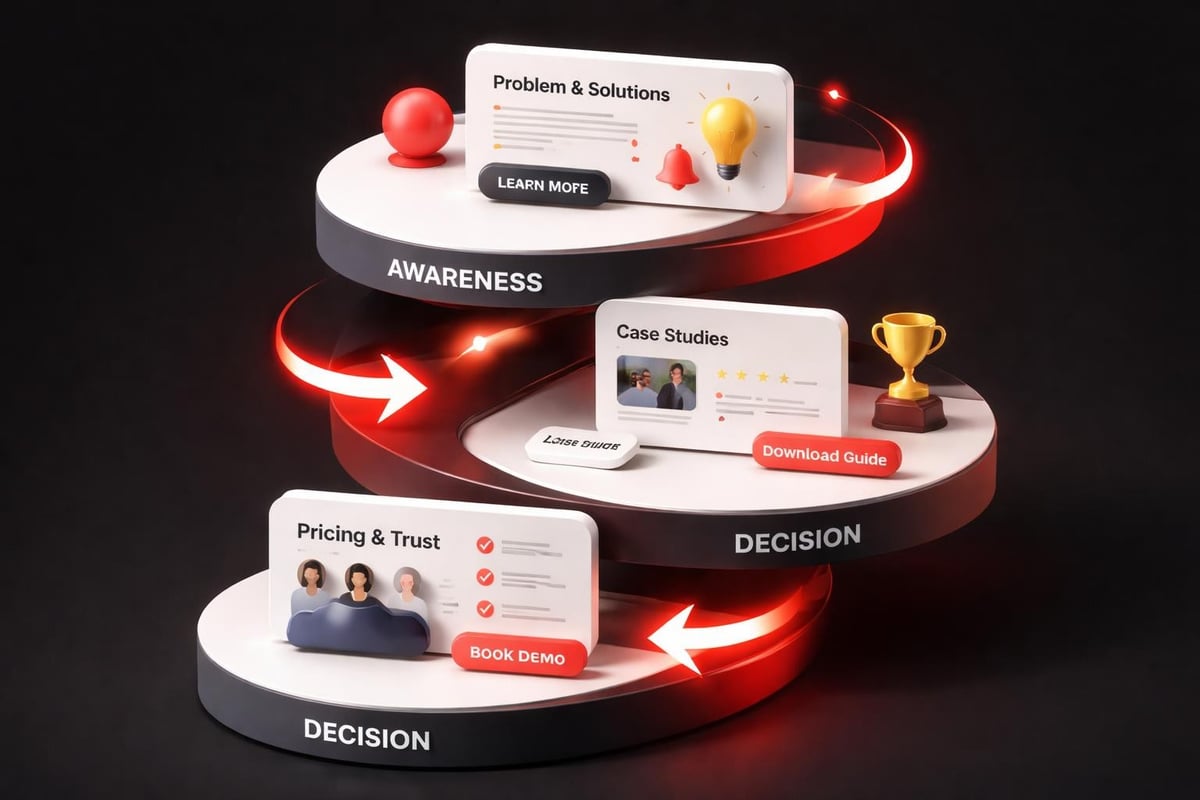
Each framework serves different conversion contexts. Early-stage awareness needs problem articulation. Solution-aware visitors need differentiation proof. Decision-stage users need implementation confidence.
Balancing Brand Voice with Search Intent
SEO and brand voice aren't opposing forces. They're complementary systems when properly architected. Search intent reveals the language users actually use when seeking solutions. Brand voice shapes how you deliver those answers with distinction.
The mistake most teams make? Optimizing for algorithms instead of humans. Keywords stuffed into unnatural phrasing signal low quality to both search engines and readers. The solution is semantic coherence, where target phrases integrate naturally into valuable explanations.
Strong brand sites maintain voice consistency while addressing search queries. This requires content systems, not one-off page creation. Templates that guide structure. Style guides that govern tone. Review processes that ensure alignment before publication.
Performance Optimization Beyond Page Speed
Site performance extends beyond loading metrics. Conversion performance measures how effectively the brand site transforms visitors into qualified opportunities. This requires instrumentation, analysis, and systematic iteration.
Critical performance dimensions:
- Engagement depth: Time on page, scroll depth, multi-page sessions
- Conversion efficiency: Form submissions per 100 visitors, segmented by source
- Content effectiveness: Which pages correlate with contact or demo requests
- Technical health: Core Web Vitals, mobile responsiveness, accessibility scores
These metrics reveal which elements drive results and which create friction. A beautiful hero section that no one scrolls past needs revision. A clunky form with high completion rates needs protection during updates.
Using Analytics to Inform Design Decisions
Data without interpretation creates noise, not insight. The brand site analytics stack should answer specific strategic questions rather than generate dashboard vanity metrics.
Key analysis workflows:
- Cohort comparison: How do users from different sources (organic search vs. referral vs. paid) behave differently?
- Path analysis: What page sequences lead to conversion vs. abandonment?
- Element testing: Which hero messages, social proof placements, or CTA variations perform best?
- Mobile vs. desktop gaps: Where does the mobile experience underperform desktop conversion rates?
Modern approaches integrate behavioral analytics tools (Hotjar, Microsoft Clarity) with conversion tracking (GA4, Plausible) to correlate qualitative observation with quantitative measurement. Watch session recordings of converted users to identify common patterns. Study drop-off points to diagnose friction sources.
This continuous learning loop prevents brand site stagnation. Insights drive hypotheses. Hypotheses inform updates. Updates generate new data. The cycle compounds improvement over time.
Maintaining Brand Sites as Living Systems
Launch isn't completion. It's version one. The best brand sites evolve continuously based on user feedback, market shifts, and business growth. This requires operational infrastructure, not just creative talent.
The maintenance architecture includes:
- Content governance: Who owns updates for different sections? What approval process balances speed with quality?
- Technical monitoring: Automated alerts for broken links, performance degradation, accessibility regressions
- Competitive analysis: Quarterly reviews of how peer brand sites evolve positioning and presentation
- User research integration: Regular testing sessions that reveal comprehension gaps or navigation confusion
Teams often underestimate the ongoing investment required to maintain brand site effectiveness. Content grows stale. Links break. New features launch without site updates. Competitive differentiation erodes as others copy successful patterns.
Treating the brand site as a product rather than a project solves this. Product thinking means roadmaps, backlogs, and sprint cycles. It means assigning ownership and measuring outcomes. It means small, frequent improvements instead of massive, infrequent redesigns.
The Case for Design Partnership Over One-Time Projects
Agencies structured around project delivery optimize for handoff, not ongoing success. The incentive is to complete the deliverable and move to the next client. In-house teams lack specialized expertise and bandwidth to maintain strategic focus.
Design partnerships offer a third model. Embedded specialists who understand your business, your users, and your growth goals. Continuous collaboration that compounds knowledge rather than restarting context with each engagement.
For example, our approach to systems in design emphasizes reusable frameworks that enable rapid iteration without rebuilding foundations. This reduces cost per update while maintaining quality standards.
Partnership advantages over project work:
- Institutional knowledge: Deep understanding of brand strategy, technical constraints, user patterns
- Faster execution: No ramp-up period or context-switching overhead
- Proactive improvement: Continuous monitoring reveals opportunities before they become urgent problems
- Strategic alignment: Design decisions connect to business metrics, not isolated aesthetic preferences
The brand site becomes a growth engine rather than a static asset. Performance improves through systematic iteration. New capabilities roll out smoothly. The site scales with the business instead of constraining it.
Integrating Brand Sites into Broader Product Ecosystems
Startups rarely succeed with a single touchpoint. Users encounter the brand through social content, product interfaces, email communications, and support documentation. Each touchpoint either reinforces or contradicts the brand site's core message.
Integration ensures coherence. Visual language from the brand site extends into product UI. Messaging frameworks guide email copy. Navigation patterns feel familiar across domains. Users develop mental models that transfer between contexts.
Integration checkpoints:
- Visual consistency: Does the product dashboard feel like it belongs to the same brand as the marketing site?
- Messaging alignment: Do sales emails echo the value propositions emphasized on key landing pages?
- Navigation logic: Can users move between site and product without cognitive friction?
- Data continuity: Does user behavior in-product inform brand site personalization?
This level of integration requires cross-functional collaboration. Design can't dictate product decisions. Marketing can't ignore technical constraints. The solution is shared systems and frameworks that multiple teams reference.
Platforms that enable this integration, like the approach we detail in Framer guide resources, reduce technical barriers to maintaining consistency. Shared component libraries. Unified design tokens. Synchronized content management.
Future-Proofing Through Modular Architecture
Technology platforms evolve. Design trends shift. Business models pivot. Brand sites built on rigid, monolithic architectures become expensive to update and impossible to adapt.
Modular thinking future-proofs investment. Pages compose from independent sections. Sections draw from shared component libraries. Components reference centralized design tokens. Updates cascade systematically rather than requiring manual rebuilds.
Modularity principles:
- Component isolation: Each element functions independently without relying on specific page context
- Content-design separation: Structure exists independent of specific copy, enabling rapid messaging iteration
- API-first integration: External data sources connect through standardized interfaces, not custom code
- Version control: Changes track systematically with rollback capability when experiments fail
This architecture enables experimentation at velocity. Test new positioning without rebuilding pages. Update visual treatments without touching content. Add functionality without breaking existing flows.
The investment in proper architecture pays compound returns. Initial development takes slightly longer as systems get established. Every subsequent update completes exponentially faster and with dramatically lower risk.
A brand site that drives measurable growth requires more than aesthetic polish. It demands strategic architecture, systematic thinking, and continuous evolution aligned with business objectives. The gap between mediocre and exceptional performance lies in treating your site as a conversion system, not a digital brochure. If you're ready to build or evolve a brand site that functions as a genuine growth engine, Embark Studio™ helps investor-backed startups design, implement, and continuously optimize high-performance digital experiences that scale with your ambition.
Get articles like this in your inbox
Practical design and growth insights for founders. No spam, unsubscribe anytime.


