

Most product teams approach AI tools the wrong way. They chase automation for automation's sake, layering platform after platform until their workflow becomes a Frankenstein of disconnected services. The real opportunity isn't replacing human judgment. It's building systems that amplify pattern recognition, eliminate repetitive friction, and free designers to focus on what actually requires creative intelligence. A no code ai platform isn't a shortcut around expertise. It's infrastructure for clearer thinking.
The Misconception About No-Code AI Tools
Founders see "no-code" and assume it means "no skill required." That's backwards.
The best no code ai platform solutions don't remove complexity. They relocate it. Instead of wrestling with Python libraries or API documentation, you're orchestrating logic, defining relationships, and mapping user intent to system behavior. The cognitive load shifts from syntax to structure. From implementation details to strategic decisions.
This matters because design systems already operate this way. You don't rebuild button variants from scratch every sprint. You establish rules, constraints, and patterns that scale across products. AI platforms work the same way when implemented correctly.
Three principles separate effective platforms from glorified templates:
- Transparency over magic - You understand what the system does and why
- Composability over presets - Components connect logically, not arbitrarily
- Iteration over automation - Workflows improve through feedback loops, not one-time deployments
When Google introduced workspace automation tools for businesses, the emphasis wasn't on removing technical barriers. It was on letting teams focus on business logic instead of infrastructure setup. That distinction defines whether AI accelerates your design process or just adds complexity.
Why Systems Thinking Beats Feature Hunting
A no code ai platform becomes valuable when it reinforces how you already think about product architecture.
Consider content generation workflows. Surface-level implementation looks like this: connect ChatGPT to your CMS, generate blog posts, publish automatically. It feels productive. It's actually chaos. You've automated production without systematizing quality control, brand consistency, or strategic alignment.
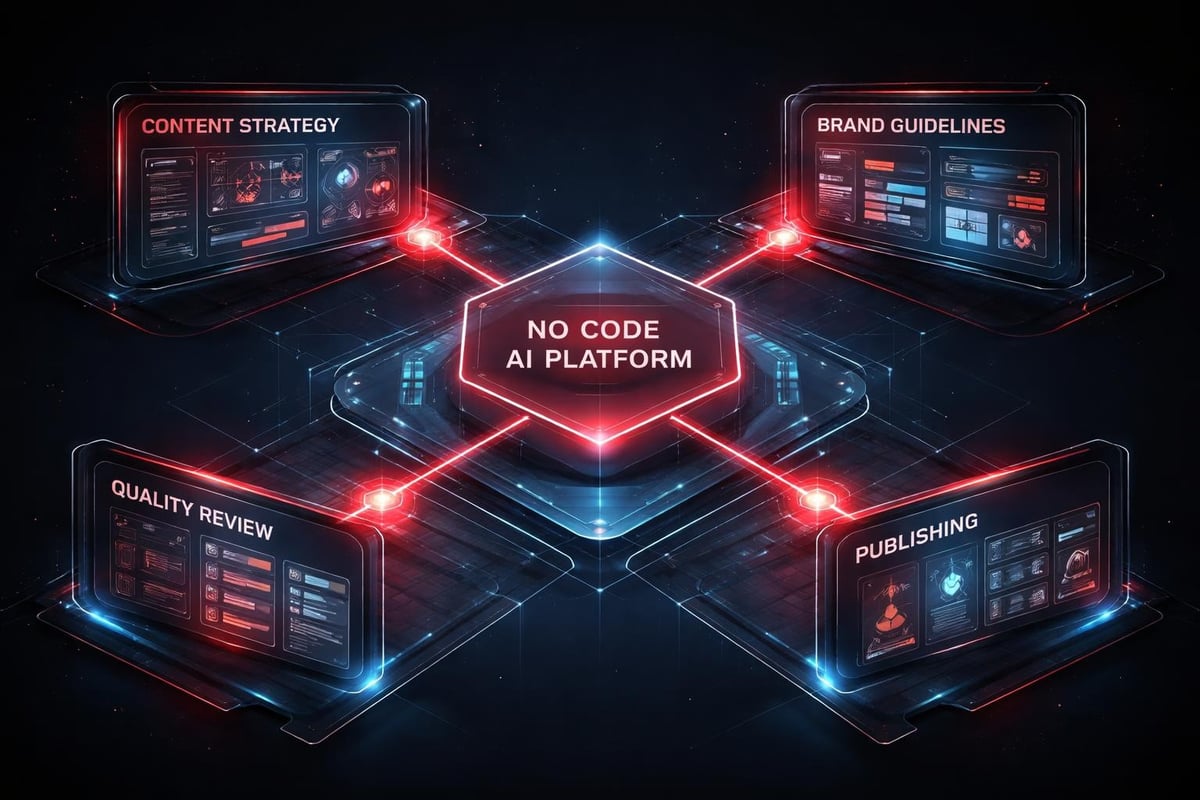
Systematic implementation works differently:
- Define brand parameters - Voice, tone, forbidden phrases, required elements
- Map decision trees - What variations need approval vs. auto-publish
- Build feedback mechanisms - How performance data refines future outputs
- Connect cross-functional touchpoints - Where design, copy, and development intersect
This isn't about AI capability. It's about workflow architecture. The platform itself becomes invisible infrastructure supporting clearer processes.
We approach AI integration in product design the same way. Tools don't drive strategy. Strategy determines which tools earn a place in the system. Every automation layer should answer: "What creative decision does this preserve capacity for?"
The Depth vs. Speed Tradeoff
Fast implementations break under scrutiny. Deep systems scale through complexity.
| Approach | Implementation Time | Maintenance Cost | Strategic Value |
|---|---|---|---|
| Quick automation | 2-4 hours | High (constant fixes) | Low (brittle workflows) |
| Systematic integration | 2-3 days | Low (self-correcting) | High (compounds over time) |
| Hybrid approach | 1 day | Medium (periodic tuning) | Medium (context-dependent) |
Most teams choose quick automation because timeline pressure overrides systems thinking. Then they spend six months firefighting edge cases that a structured approach would have anticipated.
A no code ai platform doesn't solve this. But it makes the systematic approach accessible to teams without dedicated ML engineers. You're building logic diagrams and decision flows instead of training models from scratch.
Real Application: Automating Design QA Without Losing Context
Here's where theory meets actual product development.
Say you're launching a SaaS product with dozens of marketing pages. Each page needs brand consistency, accessibility compliance, performance optimization, and conversion tracking. Manual QA catches maybe 70% of issues. Human attention drifts. Edge cases slip through.
Traditional solution: hire more QA resources or accept inconsistency.
Systematic AI solution using a no code ai platform:
- Build a design checklist agent - Scans components against your established design system
- Create an accessibility validator - Checks contrast ratios, alt text, keyboard navigation
- Deploy a performance monitor - Flags images over 200KB, scripts blocking render
- Implement a conversion tracker - Monitors CTA placement, button hierarchy, visual flow
None of these require coding. They require design thinking translated into logical rules. The platform executes checks. You define what matters.
This is where platforms like AIAP's natural language workflow builder become relevant. Instead of configuring through interfaces, you describe intent: "Flag any page where the primary CTA isn't above the fold on mobile." The system translates that into executable logic.
The result isn't perfect automation. It's systematic augmentation. Your design team still makes final calls. But they're not burning cognitive resources on repetitive verification. They're focusing on interaction nuance, emotional resonance, strategic differentiation.
How This Connects to Framer Workflows
At Embark Studio™, we build conversion-focused experiences in Framer precisely because it supports this systematic approach.
Framer's component architecture already thinks in systems. Variables, variants, and overrides create logical relationships between elements. When you layer a no code ai platform into that workflow, you're extending the same mental model.
Example: You've designed a pricing page component library in Framer. Three tiers, feature comparison tables, dynamic testimonials. Instead of manually testing every permutation across breakpoints, you build an AI agent that:
- Verifies pricing accuracy against your source of truth
- Checks that feature lists align with your product roadmap
- Confirms testimonials match current customer segments
- Validates visual hierarchy across viewport sizes
The agent doesn't design. It enforces consistency so your design team can explore higher-order problems like conversion psychology and user motivation.

Multi-Agent Systems: When One AI Isn't Enough
Single-purpose automation handles discrete tasks. Complex products require orchestrated intelligence.
Consider onboarding flow optimization. You need:
- Agent A: Analyzes user behavior patterns (where people drop off)
- Agent B: Generates variant copy for A/B testing
- Agent C: Monitors conversion impact of each variant
- Agent D: Routes high-value users to priority support
Each agent specializes. Together, they create a self-improving system.
Research from AutoGen Studio demonstrates how no-code tools can orchestrate these multi-agent architectures. You're not writing agent communication protocols. You're defining relationships: "When Agent A detects a 30% drop-off at step three, Agent B generates three alternative approaches for Agent C to test."
This matters for design teams because:
Product experiences aren't linear. User journeys branch, backtrack, and evolve based on context. Static design systems can't adapt. AI-orchestrated systems can respond dynamically while maintaining brand coherence.
But here's the critical nuance: orchestration requires design thinking, not technical wizardry. The hard part isn't connecting APIs. It's mapping user psychology to system behavior. It's understanding which moments need human empathy versus algorithmic efficiency.
A no code ai platform removes infrastructure barriers. It doesn't replace strategic judgment about when automation serves users versus undermining trust.
The Trinity Framework for Spatial Design Data
When your product involves geographic data, user location, or physical-world integration, traditional AI platforms break down.
Research into Trinity's architecture for spatial datasets reveals how specialized no-code platforms handle complex data relationships. Instead of forcing spatial information into tabular formats, the system preserves geometric relationships and topological context.
For product designers working on mapping interfaces, logistics dashboards, or location-based services, this distinction is crucial. Your no code ai platform needs to understand that proximity, boundaries, and routes aren't just data points. They're spatial relationships with behavioral implications.
Practical application: You're designing a delivery app. User sees "15 minutes away." That estimate needs to account for traffic patterns, driver behavior, historical accuracy, and user tolerance thresholds. A spatial-aware AI platform processes all those variables without requiring you to build geospatial algorithms.
You define the experience requirement: "Delivery estimates should underpromise by 10% to maintain trust." The platform handles the computational complexity.
When No-Code Platforms Actually Limit You
Honest assessment: not every workflow belongs in a no-code environment.
You need custom code when:
- Performance requirements exceed platform optimization limits
- Data processing involves proprietary algorithms with competitive value
- Integration points require real-time response under 50ms
- Regulatory compliance demands audit trails beyond platform capabilities
But most product design workflows don't hit those thresholds. Most bottlenecks are organizational, not technical. Teams waste more time on handoffs, version control confusion, and communication gaps than algorithmic optimization.
A no code ai platform solves workflow friction. It doesn't solve architectural complexity that requires ground-up engineering.
The decision matrix is simple:
| Scenario | Best Approach | Why |
|---|---|---|
| Repetitive design QA | No-code AI | High volume, clear rules, low latency tolerance |
| Brand consistency checks | No-code AI | Pattern matching against established guidelines |
| Real-time personalization | Custom code | Sub-second response, competitive differentiation |
| Predictive user modeling | Hybrid | Platform for orchestration, custom for proprietary logic |
When Google launched tools for building AI agents without prior experience, the emphasis was on business logic, not replacing engineering teams. That's the lens product designers need.
Use platforms where they preserve creative energy. Build custom where differentiation demands it.
Building Conversion Intelligence, Not Just Automation
The real competitive advantage isn't speed. It's systematic learning.
Every interaction with your product generates data about what works. Most teams collect analytics. Few translate insights into automated improvement.
Here's how a no code ai platform creates conversion intelligence:
- Deploy behavior tracking agents - Monitor scroll depth, interaction patterns, exit points
- Build hypothesis generation workflows - AI suggests test variations based on behavior clusters
- Automate variant deployment - Push tests to staging without developer handoffs
- Create feedback loops - Winning patterns automatically inform design system updates
This isn't A/B testing with AI labels slapped on. It's systematic conversion optimization where insights compound instead of disappearing into Slack threads.
We implement this thinking in every high-performance website we build. The initial design is hypothesis one. Every subsequent iteration refines based on actual user behavior, not subjective preference.

The no code ai platform makes this workflow accessible without dedicated data science resources. You're thinking in conversion psychology. The platform handles statistical significance and variant management.
The Mobile-First AI Consideration
Most no-code platforms were built for desktop workflows. Mobile introduces constraints that fundamentally change how AI should operate.
Research on AI-driven app development without coding highlights this tension. Touch interfaces demand different interaction patterns. Screen real estate limits context visibility. Network variability affects AI response reliability.
When implementing a no code ai platform for mobile-first products:
- Prioritize progressive enhancement - Core experience works without AI; intelligence layers on top
- Design for intermittent connectivity - AI features degrade gracefully when offline
- Respect attention economics - Mobile users have lower patience for AI "thinking" indicators
- Optimize for thumb zones - AI-suggested actions must align with ergonomic interaction areas
This isn't about the platform's technical capability. It's about mapping AI behavior to mobile UX principles. The automation needs to respect context constraints, not just execute logic.
Studio Thinking: Systems Over Screens, Clarity Over Noise
Every no code ai platform promises efficiency. Few deliver strategic coherence.
The difference is architectural thinking. Screens are instances. Systems are frameworks. AI automation applied to screens creates faster chaos. Applied to systems, it creates compounding clarity.
This means:
When you implement AI for content generation, you're not automating blog posts. You're building a content system with AI as one component alongside strategy, distribution, and performance measurement.
When you use AI for design QA, you're not checking individual pages. You're reinforcing design system integrity across every touchpoint.
When you deploy AI for user research, you're not replacing customer conversations. You're scaling pattern recognition so human researchers focus on depth over breadth.
The platform is infrastructure. Your design philosophy is architecture.
We've explored this extensively in our work on scalable design systems. AI amplifies systematic thinking. It can't create it where foundation is missing.
That's why tools like multimodal AI platforms for enterprises succeed or fail based on implementation approach, not feature lists. The technology enables. Your team's systems thinking determines results.
The Soft CTA: Frameworks Over Features
If you're reading this far, you already understand the distinction between AI as novelty versus AI as infrastructure.
The next question is implementation. How do you translate these principles into your actual product development workflow? That's where frameworks matter more than features.
At Embark Studio™, we've built systematic approaches for integrating AI into design processes without losing creative control. Not because AI is magic. Because clear workflows make room for strategic thinking.
Whether you're building in Framer, coordinating across Figma and development, or orchestrating multi-platform experiences, the core principle remains: systems compound, screens don't.
A no code ai platform is valuable when it reinforces that principle. When it helps you build clearer rules, stronger patterns, and more coherent experiences. When it becomes invisible infrastructure instead of the star of the show.
The platforms will evolve. Your design philosophy should remain constant: depth over speed, clarity over complexity, systems over hype.
The shift toward intelligent automation isn't about replacing designers. It's about building infrastructure that preserves creative capacity for problems that actually require human judgment. Whether you're implementing your first no code ai platform or refining existing workflows, the opportunity lies in systematic thinking, not feature collection. At Embark Studio™, we partner with startups to build these kinds of scalable, AI-assisted design systems that drive measurable growth without sacrificing strategic clarity. If you're ready to move beyond surface-level automation and build conversion-focused experiences that compound over time, let's design that system together.
Get articles like this in your inbox
Practical design and growth insights for founders. No spam, unsubscribe anytime.


