

AI website builder tools flooded the market in 2025 and 2026, promising anyone could launch a professional site in minutes. The pitch sounds perfect for startups moving fast. But the reality is more nuanced. These platforms solve specific problems well while creating new constraints you won't notice until you've already committed. Understanding which problems they solve and which they create determines whether you're building on a foundation that scales or painting yourself into a corner.
What an AI Website Builder Actually Does
An ai website builder uses machine learning models to generate layouts, copy, and design elements based on prompts or questionnaires. You answer questions about your business. The system outputs a functioning website.
The technology improved dramatically since 2024. Wix introduced Harmony, an AI agent that takes natural language commands and translates them into design changes. Squarespace launched Blueprint AI to generate complete sites from brief descriptions. Duda optimized for what they call Answer Engine Optimization, generating sites that attract significantly more human traffic by structuring content for AI search engines.
Core Capabilities in 2026
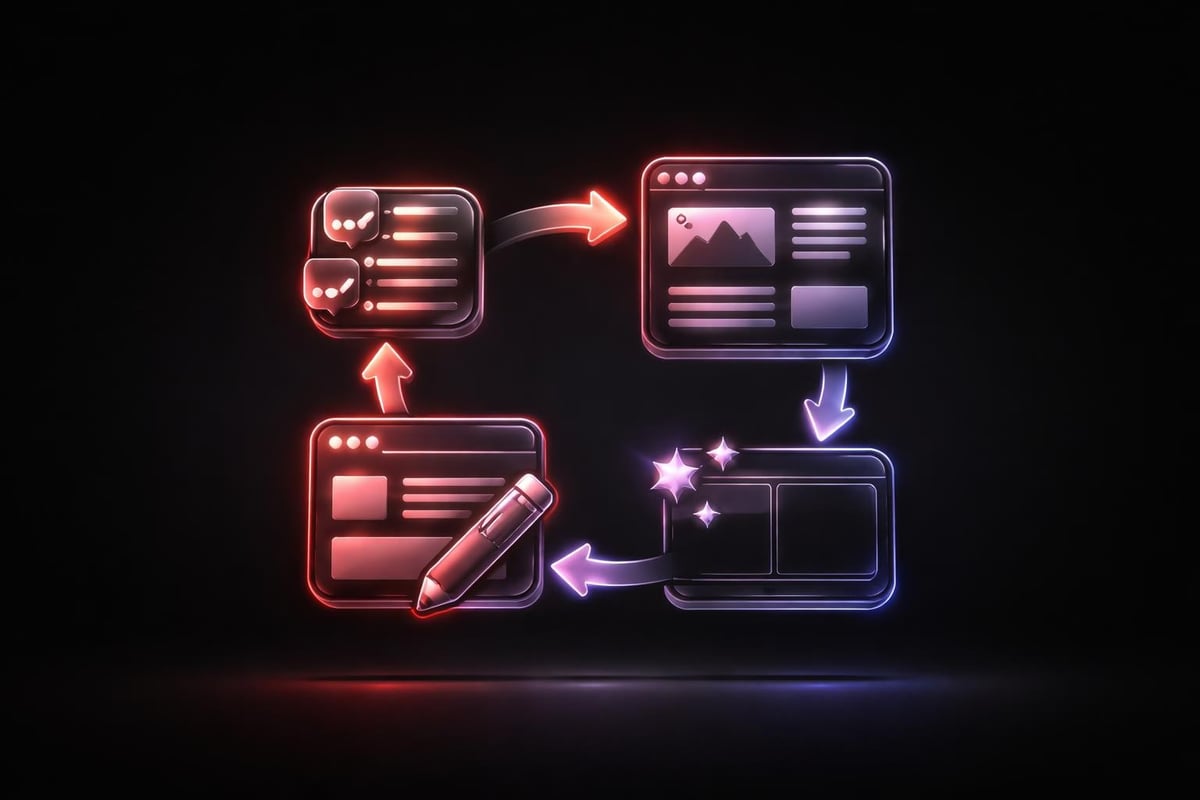
Current platforms handle these tasks without human intervention:
- Layout generation based on industry templates and competitive analysis
- Copywriting for hero sections, feature descriptions, and basic CTAs
- Image selection from stock libraries matched to content themes
- SEO foundation including meta tags, heading structure, and schema markup
- Mobile responsiveness with automatic breakpoint optimization
- Form creation for lead capture with CRM integrations
The output quality varies wildly. Some tools produce generic results that look identical across competitors. Others generate surprisingly competent first drafts that need refinement, not rebuilding.
The Real Value Proposition
Speed is the obvious benefit. You get something live in hours instead of weeks. But speed only matters if you're building the right thing.
The actual strategic value comes from iteration velocity. An ai website builder lets non-technical teams test messaging, positioning, and offers without developer dependencies. You can swap hero copy, restructure navigation, or A/B test layouts the same day you have the idea.
When This Matters Most
Early-stage companies validating product-market fit benefit from this flexibility. You're not optimizing for brand consistency. You're learning what resonates. Quick tests beat pixel-perfect execution.
But there's a ceiling. Once you know what works, you need systems that compound value over time. Templates cap your ability to differentiate. AI-generated copy sounds competent but rarely sounds like your brand. The same tools that accelerated exploration become constraints on growth.
| Stage | Best Tool Type | Why |
|---|---|---|
| Pre-product/market fit | AI website builder | Maximum iteration speed, minimal investment |
| Early traction (0-10 customers) | AI builder or custom Framer | Depends on brand importance to positioning |
| Scaling (10-100 customers) | Custom design system | Differentiation and conversion optimization matter |
| Growth (100+ customers) | Full design system + CMS | Compound improvements across touchpoints |
The transition point matters. Waiting too long means you're converting below potential. Moving too early means wasted investment in infrastructure you're not ready to leverage.
What AI Website Builders Don't Do Well
The limitations matter more than the features for companies with growth ambitions. These platforms optimize for getting something live, not for what happens after.
Brand Differentiation
AI models train on existing websites. They generate variations of what already exists. This creates a homogenization problem. Your competitors using the same platform will have sites that look structurally similar because they're built from the same templates and trained on the same data.
For commodity businesses where price and availability drive decisions, this doesn't matter. For companies where brand perception influences purchase decisions, it's a significant constraint. You can't build a distinctive brand identity inside a system designed to output familiar patterns.
Conversion Optimization
Website conversion rate depends on psychology, positioning, and proof elements working together. AI builders handle the mechanical parts like form placement and button visibility. They don't understand the strategic architecture that drives conversion.
Real conversion optimization requires:
- Value hierarchy that surfaces the most compelling benefit first for each segment
- Trust sequences that introduce proof points at decision moments
- Friction reduction that removes cognitive load from the conversion path
- Specificity in messaging that speaks to actual customer problems
An ai website builder can't do this because it doesn't know your customers, your positioning, or your unit economics. It generates reasonable defaults. Defaults convert below potential.
System Thinking
Templates solve discrete page problems. Business websites are systems where components, messaging frameworks, and visual patterns create consistent experiences across touchpoints.
Growing companies need design systems that evolve. A component library where buttons, forms, and cards maintain visual consistency. Messaging frameworks where value propositions cascade from homepage to product pages to case studies. Brand guidelines that inform not just the website but sales decks, product UI, and marketing campaigns.
AI website builders don't think in systems because they optimize for initial output, not long-term scalability. You get pages, not architecture.

The Hidden Costs Nobody Mentions
The sticker price for an ai website builder looks attractive. Most platforms charge $20-40 monthly for business features. Custom design starts at $10,000 and goes up from there.
But comparing initial costs misses the total cost of ownership over time. Budget for these hidden expenses:
Migration Costs
Most platforms lock you into their ecosystem. Moving your site to another platform or custom infrastructure later requires rebuilding from scratch. Content might export, but design, integrations, and custom functionality don't.
This creates switching costs that compound over time. The longer you build on a platform, the more expensive it becomes to leave. You're not just paying monthly fees. You're paying in future flexibility.
Opportunity Costs
A generic site converting at 2% when a optimized site would convert at 4% costs you revenue on every visitor. For a company driving 10,000 monthly visitors worth $100 each, that 2 percentage point gap costs $20,000 monthly in unrealized revenue.
Over a year, the opportunity cost of a template site is $240,000. Custom design that improves conversion by 2 points pays for itself in the first month.
Integration Limitations
AI website builders support popular integrations through marketplace apps. They don't support custom integrations with your internal tools, proprietary data sources, or specialized workflows.
This creates process fragmentation. Marketing data lives in the website platform. Customer data lives in your CRM. Product analytics live in your app. Nobody has a complete view, so decisions get made on incomplete information.
How Professional Teams Actually Use These Tools
Smart design teams don't treat ai website builder platforms as either/or decisions. They use them strategically for specific use cases while building core properties on custom infrastructure.
Rapid Prototyping
Product design studios use AI builders to test positioning concepts before investing in full design. Generate three variations of homepage messaging. Drive traffic. Measure which resonates. Build the winner properly.
This splits strategy validation from execution. You learn what works fast, then commit resources to execution that compounds value.
Satellite Properties
Companies with strong core websites use AI builders for one-off campaigns, regional microsites, or product launches that don't justify custom development. The main brand property maintains differentiation. Satellite properties optimize for speed.
Content-Heavy Properties
Knowledge bases, documentation sites, and resource libraries benefit from AI builders' content management capabilities. These properties optimize for information architecture and search functionality, not brand expression. Templates work fine.
The Security Question You Should Ask
Security vulnerabilities in AI website builders emerged as a significant concern in late 2025. Lovable, a prominent AI platform, suffered a breach where attackers exploited the AI generation system to inject malicious code into user sites.
The attack vector was clever. Hackers fed prompts designed to generate code that looked legitimate but contained backdoors. The AI model, trained to be helpful, obliged. Sites got deployed with vulnerabilities built in.
This exposes a fundamental challenge with AI-generated code. Human developers can review every line. AI systems generate too fast for manual review. You're trusting the model's training data and guardrails to prevent malicious output.
For startups handling customer data or payment information, this risk matters. Evaluate platforms based on:
- Code review processes before deployment
- Security audits by third parties
- Incident response history and transparency
- Data isolation between customer sites
- Rollback capabilities if issues emerge
Most consumer-focused AI website builders prioritize ease of use over security rigor. Enterprise platforms take security more seriously but cost significantly more.
Pricing Models and What They Reveal
Wix pricing structures in 2026 show how platforms tier features to maximize revenue. The pattern appears across most AI builders:
Free tier: Branded domain, limited features, ads on your siteBasic ($16/month): Custom domain, no ads, basic templatesBusiness ($27/month): AI features, advanced analytics, integrationsEnterprise ($custom): White-label, API access, dedicated support
The AI capabilities sit in business and enterprise tiers. You're not paying $16 for an ai website builder. You're paying $27 minimum, and features you'll need as you grow (team collaboration, version history, advanced SEO) push you to enterprise.
Calculate total cost over 36 months including the tier you'll actually need. Compare that to custom development cost. Often the gap is smaller than it appears, especially when you factor in opportunity costs from conversion rate differences.
When Custom Development Makes More Sense
An ai website builder makes strategic sense in specific situations. Custom development makes sense in others. The decision framework:
Choose AI builders when:
- You're validating business model or positioning
- Timeline matters more than differentiation
- Budget is under $5,000 total
- You need something live this week
- Design quality doesn't influence purchase decisions
Choose custom development when:
- Brand perception drives competitive advantage
- You're optimizing for conversion, not just presence
- You need systems that evolve with the business
- You have product/market fit and are scaling
- You're in a competitive market where differentiation matters
For startups working with design partners who understand growth, the approach combines both. Use AI tools for rapid concept testing. Build on custom infrastructure for properties that drive revenue.

The Framer Alternative
Framer occupies interesting middle ground between AI website builders and fully custom development. It's a design tool that outputs production code, combining visual design freedom with technical performance.
The workflow differs from traditional AI builders:
- Design in Framer with complete creative control
- Add interactivity using built-in components and logic
- Connect data from CMS, APIs, or databases
- Deploy directly without developer handoff
This gives you custom design quality without custom development timelines or costs. A skilled designer can build production-ready sites in Framer as fast as configuring an ai website builder, but with complete control over every pixel.
The limitation is skill requirement. Framer isn't point-and-click simple. It requires design competency. For teams without design resources, it doesn't solve the problem. For teams with design resources, it's often the better path than both AI builders and traditional development.
AI-Assisted Workflows Versus AI-Generated Output
The most effective approach in 2026 isn't choosing between human design and AI generation. It's using AI to accelerate human judgment, not replace it.
Professional design teams use AI for:
- First-draft copywriting that gets refined by strategists who understand positioning
- Layout exploration that generates options designers select and refine
- Image sourcing that finds relevant visuals faster than manual search
- SEO foundation that structures content for both humans and algorithms
- Accessibility testing that flags issues before they reach production
The output is better than pure AI generation because humans make strategic decisions. It's faster than pure human work because AI handles mechanical tasks.
This is how Embark Studio™ builds high-converting websites for growth-stage startups. AI tools accelerate the process. Design thinking and brand strategy drive the outcome. You get speed and quality, not speed or quality.
What Happens After Launch
An ai website builder gets you live. What happens next determines whether you built an asset or created technical debt.
Template sites tend to become maintenance burdens. You want to add a feature that doesn't fit the template structure. You want to integrate with a tool that isn't in the marketplace. You want to optimize conversion on a page where the template constrains layout options.
Each limitation creates workarounds. Workarounds create fragmentation. Fragmentation creates maintenance overhead. Two years later, you're spending more time fighting the platform than improving the site.
Custom-built sites with proper architecture create the opposite dynamic. Changes get easier over time because you have systems instead of pages. Add a new product? The component library already has card styles, CTAs, and layouts. Expand to a new market? The design system adapts to regional content without rebuilding.
This is the compounding value that templates can't deliver. Initial investment is higher. Long-term cost of ownership is lower.
Making the Decision
Evaluate AI website builders based on what you're optimizing for. If speed is the only constraint, use one. If you're building a business where brand and conversion drive growth, invest in systems that scale.
Ask these questions:
Timeline: Do you need something live in days or can you invest weeks for better output?
Budget: What's the 36-month total cost including opportunity costs from conversion rate differences?
Differentiation: Does brand perception influence purchase decisions in your category?
Team: Do you have design resources or need everything automated?
Growth trajectory: Will you outgrow template constraints in 6 months or 2 years?
Integration needs: Do you need custom connections to internal tools?
The answers determine the right path. There's no universal answer. An ai website builder is the right choice for some companies and the wrong choice for others.
Platform Comparison Framework
Evaluating specific platforms requires looking beyond feature lists to strategic fit. Here's what actually matters:
| Factor | Wix | Squarespace | Framer | Custom |
|---|---|---|---|---|
| Setup speed | Hours | Hours | Days | Weeks |
| Design flexibility | Low | Medium | High | Complete |
| AI capabilities | Advanced | Moderate | Emerging | Manual |
| Conversion optimization | Templates | Templates | Custom | Custom |
| Migration path | Locked | Locked | Portable | Owns code |
| Learning curve | Minimal | Minimal | Moderate | High |
| Monthly cost | $27-300 | $25-500 | $0-50 | $0-500 |
| Development cost | $0 | $0 | $2-8K | $10-50K |
Wix's AI website builder leads in automation but locks you in completely. Squarespace offers better design quality but similar constraints. Framer gives you control with steeper learning curves. Custom development maximizes flexibility at highest cost.
Choose based on what you can't compromise on. If it's speed and cost, go AI. If it's control and scalability, go custom. If it's balanced, explore Framer or hybrid approaches.
The Brand Consistency Problem
Companies using ai website builder platforms for their main site often create brand fragmentation without realizing it. The website looks one way. The product UI looks different. Sales materials use different visual language. Nobody planned it. Different tools with different constraints produced different outputs.
This matters more as you scale. Early customers forgive inconsistency. Later customers notice polish. Enterprise buyers evaluate brand maturity as a proxy for company maturity.
Building from systems instead of templates prevents this. A design system that defines your visual language, component library, and interaction patterns creates consistency across every touchpoint. The website uses the same components as the product. Sales decks use the same visual language. Everything feels like one company.
AI website builders can't do this because they think in pages, not systems. You get one solution for one problem. Solving the whole problem requires different tools.
AI website builders solve real problems for specific use cases. They accelerate initial deployment and reduce dependency on technical resources. But they create constraints that matter more as you grow. The key is matching tool choice to business stage and strategic priorities. For startups ready to move beyond templates and build systems that compound value over time, Embark Studio™ combines AI-assisted workflows with strategic design thinking to deliver conversion-focused websites that scale with your business.
Get articles like this in your inbox
Practical design and growth insights for founders. No spam, unsubscribe anytime.


