

Many still worry that AI will erase creativity from the design process. In reality, automated content generation is transforming how designers, marketers, and strategists work, not replacing them.
This guide reveals how psychology, systems, and clear processes help teams harness automated content generation for clarity, rhythm, and efficiency at scale.
You’ll discover the journey from manual to intelligent automation, the design principles that create real engagement, and UI scenarios where AI accelerates—not overrides—human creativity.
Ready to rethink your approach? Let’s explore why systems thinking and thoughtful frameworks are essential for high-performance content in 2026.
The Evolution of Automated Content Generation: 2020–2026
Automated content generation is often misunderstood as a cold, creativity-replacing force. In reality, its evolution tells a different story. The journey from manual workflows to intelligent systems reveals how design thinking, AI, and human oversight combine to create clarity, rhythm, and efficiency at scale.

From Manual Workflows to Intelligent Systems
Just a few years ago, automated content generation was a distant goal. Content teams relied on manual processes: writing, editing, and publishing each piece by hand. Bottlenecks were everywhere. Projects stalled in endless review cycles, and scaling content for multiple channels felt impossible.
Step by step, rule-based automation emerged. Scheduling tools, content templates, and simple scripts chipped away at repetitive tasks. Yet, these tools often lived in silos, creating more noise than clarity. The promise of automation was speed, but real transformation was still out of reach.
That changed between 2024 and 2026. Large Language Models, context-aware AI, and semantic search redefined what automated content generation could achieve. Suddenly, systems could understand nuance, adapt to context, and orchestrate entire content operations. Brands like global retailers moved from scattered workflows to unified, automated systems—where every asset, brief, and approval looped seamlessly together.
According to Smartling, by 2025, 65% of enterprise content was AI-assisted. This leap in efficiency is echoed in findings from AI's Impact on Content Creation Efficiency, which details how generative AI workflows unlocked unprecedented scale and speed.
Still, the most successful brands understood one thing: automation works best when it supports creative intent. Systems should amplify clarity and rhythm, not replace the designer’s vision.
Psychology of Automation: Trust, Control, and Human Oversight
Clarity and consistency matter more than raw speed in automated content generation. Teams often worry about losing control or diluting their brand’s voice. The psychological barrier is real. Trust in automation builds slowly, especially when creative work is at stake.
Studio thinking reframes the challenge. Systems are not noise machines—they create order, predictability, and space for creativity. Embedding human oversight ensures that every output keeps its rhythm, depth, and authenticity.
Consider marketing teams using automated workflows with built-in human review. These teams outperform those relying solely on automation. They catch subtle tone shifts, align with brand strategy, and maintain a higher standard of quality.
The lesson is clear: automation should never mean abdication. When automated content generation is guided by human clarity and rigorous review, it elevates both the process and the product.
Core Design Principles for Automated Content Generation
In the rush to embrace automated content generation, many teams make a critical mistake—they chase output volume, not clarity. The real challenge is not producing more, but ensuring each piece cuts through the noise, delivers rhythm, and keeps the brand’s voice unmissable.

Clarity Over Noise: The Foundation of Effective Automation
Automated content generation should always begin with clarity, not just speed. When automation floods channels with generic content, audiences tune out, and brand trust erodes. Instead, clarity acts as the anchor—every message, headline, and visual must serve a clear purpose.
Rhythm and structure turn content from chaotic bursts into a reliable cadence. Imagine a content calendar UI that visually maps posts across weeks, using color and spacing to enforce predictability. This lets audiences anticipate value, not randomness.
Depth sets effective automated content generation apart from AI spam. Systems must be anchored in brand purpose, using frameworks that guide tone, themes, and audience needs. For example, a modular calendar can flag off-brand topics before they reach the public, keeping every automated output aligned and meaningful.
Studio thinking means every piece fits a larger architecture. Screens are just endpoints—systems enforce clarity at every step. This elevates automated content generation from tactical output to strategic asset.
Human Creativity: The Irreplaceable Ingredient
No matter how advanced automated content generation becomes, AI is an accelerator, not a creator. Human creativity brings nuance, differentiation, and emotional resonance that algorithms cannot replicate.
Consider the difference between AI-generated headlines and human-edited narratives. The former might achieve relevance, but only people can weave in subtle storytelling, pacing, and brand color. Good design psychology uses tone, color, and timing to guide audience emotion and action—elements machines alone cannot master.
Modern workflows embed human checkpoints into automation. Editors review drafts, refine rhythm, and ensure that content feels alive, not robotic. This blend of automation and oversight is core to Human-Centered AI Design Guide thinking, where tools support, but never replace, the creative vision.
Ultimately, systems thinking wins. Automated content generation should elevate clarity, rhythm, and depth—never dilute them. At Embark Studio™, our frameworks are built to keep the human spark at the center of every system, driving scalable, high-performance content into the future.
The 2026 Automated Content Workflow: Step-by-Step
The misconception? Automated content generation is just about speed. In reality, the 2026 workflow is a design-driven system that prioritizes clarity and brand depth above all.
Every step is intentional, blending AI acceleration with human creativity. Let’s break down the process, layer by layer, to show how modern teams orchestrate content at scale—without losing rhythm or voice.
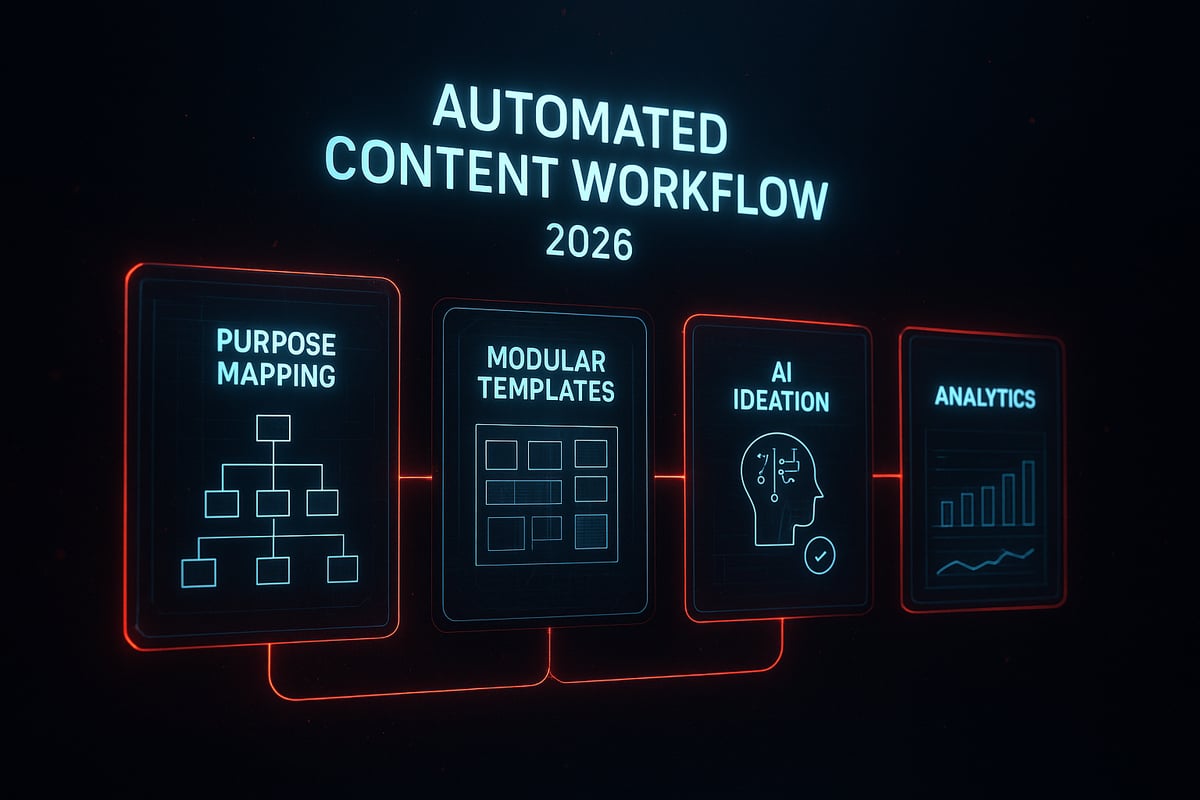
Step 1: Define Purpose and Audience
Begin with intent. Automated content generation only succeeds when each piece solves a real problem for a defined audience. Map out personas and their journeys, using tools that visualize stages, pain points, and content needs.
In the UI, this means a dynamic dashboard where teams input campaign goals, select personas, and preview journey maps. Clarity at this stage sets the rhythm for every automated output.
Step 2: Build Modular Content Systems
Next, create modular templates for headlines, body text, CTAs, and visuals. This is the backbone of automated content generation—templates ensure consistency while enabling rapid adaptation.
A modern UI example: a drag-and-drop content builder, where templates are mapped to specific brand guidelines. This approach mirrors the principles found in Scalable Design Systems in 2026, showing how modularity fuels both creativity and control.
Step 3: Integrate AI for Ideation and Drafting
With systems in place, introduce AI as a research and drafting assistant. Automated content generation tools suggest topics, outlines, and initial copy, drawing on real-time data and competitive trends.
Picture a UI panel that surfaces trending topics, relevant stats, and competitor headlines—offering a springboard, not a finished product. Human editors always have the final say, ensuring outputs align with the intended rhythm and voice.
Step 4: Human Review and Brand Alignment
Human oversight is the safeguard. Automated content generation should never bypass review checkpoints for tone, clarity, and rhythm. Editors use guided checklists within the UI—verifying that every piece fits the larger campaign architecture.
This step is where nuance, story, and brand differentiation are preserved. Systems thinking ensures that creativity is enhanced, not diluted.
Step 5: Continuous Measurement and Iteration
Finally, set clear KPIs—engagement, conversion, and consistency. A real UI example: analytics dashboards that visualize content health, with feedback loops for optimization.
Teams review performance, tweak templates, and adjust automation rules. Iteration becomes part of the system, ensuring automated content generation evolves alongside audience needs.
Studio thinking? Every step is a blueprint, not a shortcut. The future belongs to those who build clarity, rhythm, and feedback into their core frameworks. Embark Studio™ continues to refine these systems, always aiming for deeper resonance and scalable design.
Real-World UI Scenarios: Automated Content in Action
Many still believe automated content generation produces only soulless, generic outputs. In reality, the design of these systems—and their interfaces—determines whether brands unlock clarity, rhythm, and efficiency or simply add noise. Let’s break down three real-world UI scenarios that show how systems thinking turns automation into an accelerator, not a replacement, for creativity.
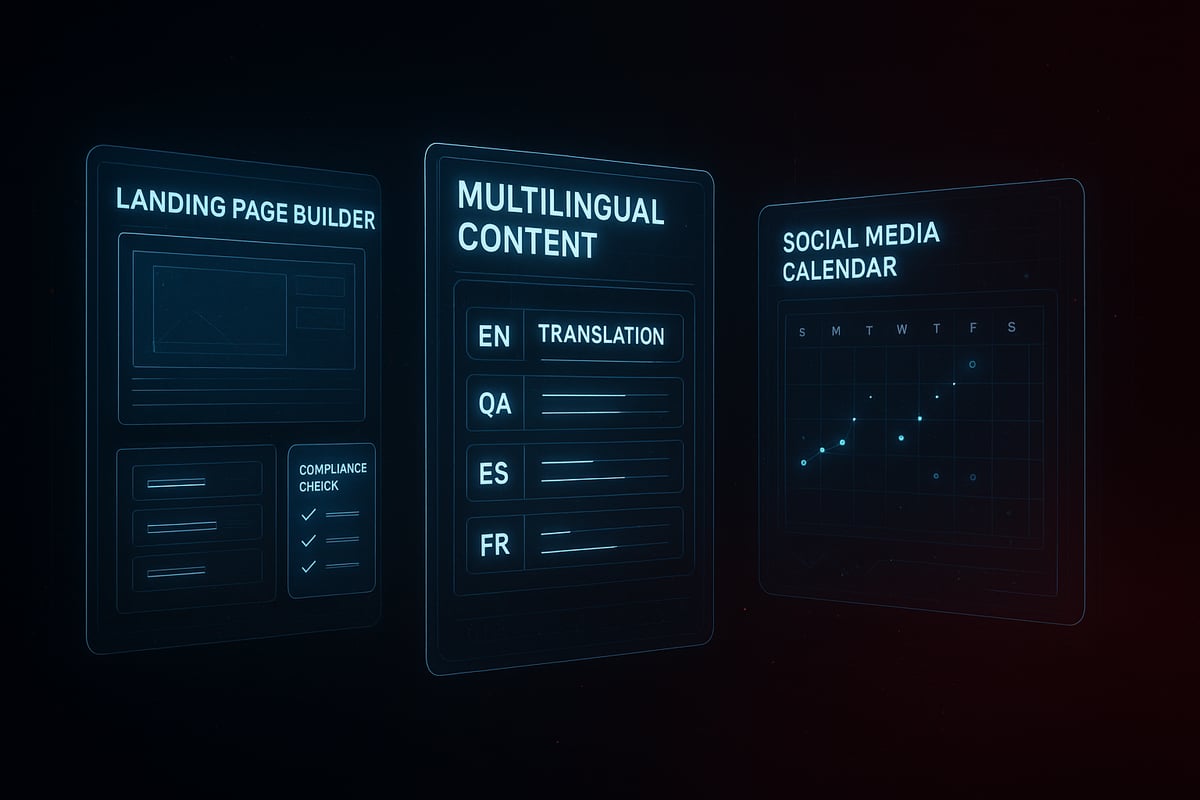
Scenario 1: Automated Landing Page Generation
Scaling personalized landing pages for dozens of campaigns used to overwhelm even the best teams. With automated content generation, modular templates and AI-driven copy now power high-velocity, on-brand pages. The real breakthrough is not just speed, but a UI that visually enforces brand compliance—think: live color checks, copy tone indicators, and instant layout previews.
A typical interface reveals a step-by-step assembly line. Designers select page modules, while AI suggests headline and layout variations, referencing performance data. Importantly, before launch, human editors review every element for clarity and rhythm. This hybrid flow ensures that automation amplifies creative intent, not replaces it. As seen in AI's Influence on Content Creation Across Industries, leading brands now rely on automated content generation to deliver consistent, high-performing landing pages at scale.
Scenario 2: Multilingual Content at Scale
Maintaining brand voice across global markets is daunting. Automated content generation streamlines translation workflows with real-time dashboards. The UI highlights translation progress, flags for human QA, and tracks quality metrics side-by-side.
Teams see at a glance where human attention is needed. Automated drafts accelerate speed, but embedded checkpoints ensure nothing launches without a final human review. This design system keeps messaging clear and consistent, regardless of language or region. Rhythm emerges from scheduled releases and transparent oversight, not from pure automation.
Scenario 3: Automated Social Media Campaigns
Coordinating social campaigns once meant endless spreadsheets and missed handoffs. Now, automated content generation enables visual calendars that map out post cadence, audience segments, and performance analytics in one place.
Editors use AI to generate draft copy and optimize timing, but they still refine tone and context for each post. The UI’s structure—color-coded statuses, rhythm indicators, and feedback loops—creates a living system where clarity and brand voice are never lost. Automation here is about orchestrating flow, not replacing the creative spark.
Real-world UI scenarios like these prove that automated content generation, when built on systems thinking, delivers scale without sacrificing quality. At Embark Studio™, we’re constantly evolving frameworks to help brands architect clarity, rhythm, and depth into every automated workflow.
The AI Angle: How Automation Accelerates, Not Replaces, Creativity
AI in 2026 is surrounded by a persistent myth: that automation replaces creative professionals. The reality is different. In automated content generation, AI acts as a catalyst, not a substitute. It streamlines the tedious, repetitive steps, freeing designers and strategists to focus on clarity, rhythm, and intent. This shift is not about removing the human touch, but about amplifying it through thoughtful systems.
AI as a Workflow Accelerator
Automated content generation now begins with a clear problem and a mapped audience. In this process, AI tools act as accelerators. They suggest topics, analyze trends, and draft outlines within seconds. Human designers use these AI-driven insights to iterate and refine, not to hand over control. For example, a content strategist working with an AI-powered brief generator can quickly align campaign goals, tone, and timing, ensuring the first draft is always on-brand. This workflow, examined in the Guide to AI in Product Design, highlights how automation supports high-velocity ideation while keeping creative decisions in human hands. The result is a system where clarity and rhythm are built into every stage of automated content generation.
Guardrails for Quality and Consistency
Speed alone does not guarantee quality. Automated content generation requires robust guardrails to maintain brand voice and depth. Human-in-the-loop systems are essential, embedding review checkpoints and brand alignment into every workflow. Marketing teams that combine AI automation with human oversight see higher engagement rates and fewer missteps. According to AI Adoption in Content Marketing, brands using hybrid workflows achieve up to 30 percent more audience engagement than those relying solely on automation. Studio thinking prioritizes clarity over noise, ensuring that every automated output is both purposeful and differentiated.
Soft CTA: Harnessing Systems Thinking for Scalable Content
The future of automated content generation is not about chasing the latest tool, but about building adaptive systems. Studio-driven frameworks add structure, rhythm, and depth to every campaign. As you explore your own automation strategy, consider how modular templates and feedback loops can scale creative impact without sacrificing quality. Embark Studio™ continues to refine these systems, championing design frameworks where clarity and continuous improvement drive results.
Building Your Automated Content System for 2026 and Beyond
The biggest misconception about automated content generation is that it’s just a shortcut for speed. In reality, it’s about building a system that can scale, adapt, and deliver consistent clarity across every touchpoint. The future belongs to brands that architect systems, not those who chase scattered tools.
Architecting for Scale: From Single Campaigns to Global Systems
Too many teams start with ad hoc automation, only to hit a wall when growth demands structure. True scalability in automated content generation begins with modular templates, robust workflows, and analytics that connect every layer—no more siloed campaigns or scattered brand messaging.
Imagine a global brand shifting from dozens of disconnected content calendars to a unified, automated system. Now, every asset—headline, image, CTA—is orchestrated through reusable modules. Human review cycles are embedded at each step, ensuring brand voice and clarity remain intact.
For small businesses, this shift is just as critical. As outlined in Automation for Small Business Growth, automation is no longer optional but foundational for sustainable scale. The lesson: systems thinking beats shortcuts every time.
Measuring What Matters: KPIs and Continuous Optimization
With automated content generation, measurement is your compass. The right KPIs drive alignment between creative intent and business results. Focus on engagement, conversion rates, brand consistency, and speed to market.
Consider a dashboard that brings these metrics to life:
| Metric | What it Reveals | Studio Insight |
|---|---|---|
| Engagement | Content resonance | Clarity |
| Conversion | Effectiveness of messaging | Rhythm |
| Brand Consistency | Voice and visual alignment | Depth |
| Speed to Market | System agility | Iteration |
A robust system constantly feeds performance data back into the workflow. Human editors use these insights to refine both AI and manual processes, ensuring every iteration sharpens clarity and rhythm. Automated content generation is only as strong as its feedback loop—continuous measurement is non-negotiable.
Future-Proofing: Adapting to Tech and Audience Shifts
Nothing about automated content generation stands still. As platforms, AI models, and audience behaviors evolve, your system must remain agile. This means designing for modularity, embedding update cycles, and building feedback channels that surface new trends before they become problems.
Studio thinking means clarity and rhythm are perpetual goals, not one-time achievements. As highlighted in AI's Role in Content Marketing Strategies, the brands winning in 2026 are those who continually refine their frameworks, not those who rest on last year’s playbook.
The toolkit is always in progress. At Embark Studio™, we see automated content generation as an ongoing system—one that adapts, iterates, and scales with every campaign. The future is modular, methodical, and relentlessly focused on clarity.
If you’re ready to move beyond surface-level automation and actually design content systems built for clarity, rhythm, and real growth, you don’t have to go it alone. We’ve helped founders and product teams architect scalable, conversion-focused experiences—combining the best of AI, design thinking, and continuous iteration. If you’re curious how these systems could accelerate your startup’s journey in 2026 and beyond, let’s connect for a no-pressure chat. We’ll dig into your challenges and show you what’s possible, step by step. Book your Free Discovery Call and explore what’s next, together.
Get articles like this in your inbox
Practical design and growth insights for founders. No spam, unsubscribe anytime.


