

Most startups launch websites and assume the work is done. The design looks sharp, the copy converts, and the code ships clean. Then three months pass. Loading times creep upward. A critical form breaks on mobile. A security patch sits unapplied. Traffic stalls, and no one knows why. This is the hidden cost of treating your website as a finished artifact instead of a living system. Website support isn't about fixing things when they break-it's about building momentum through continuous, strategic improvement. It's the difference between a static digital presence and a conversion engine that compounds over time.
The Misconception: Support Equals Firefighting
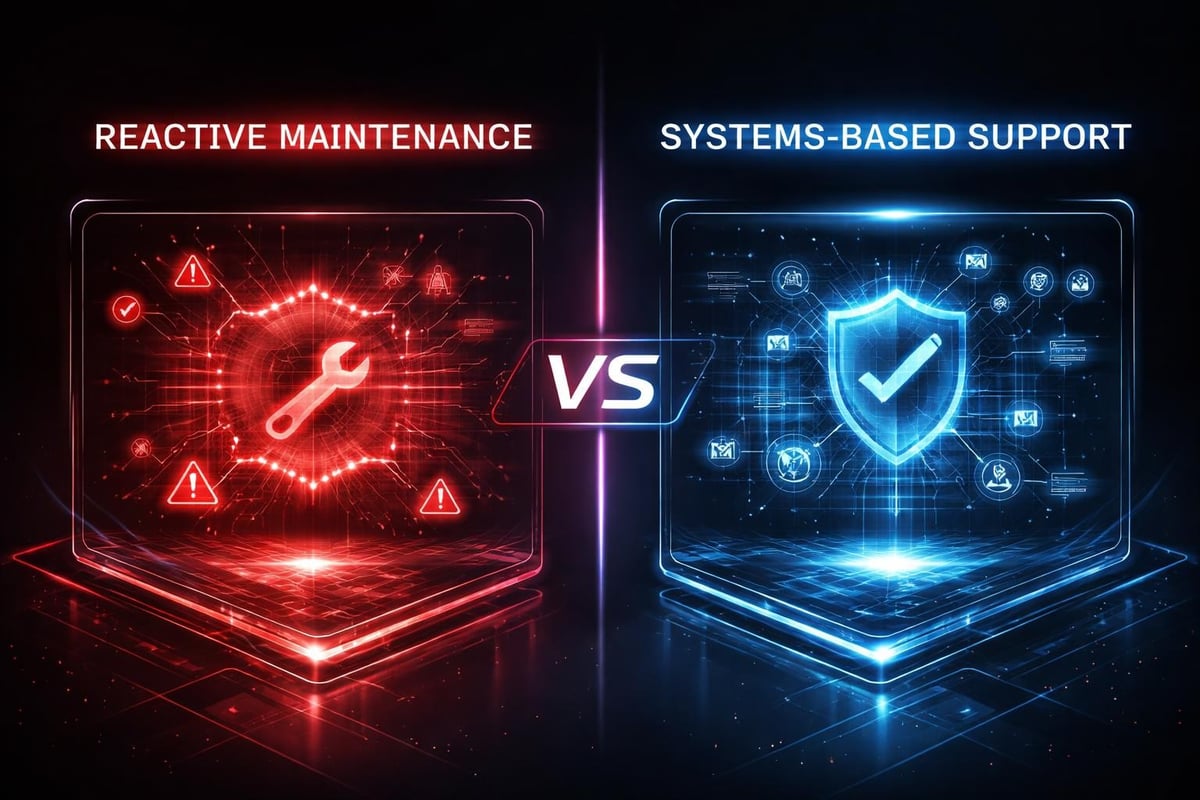
Most founding teams think of website support as reactive maintenance. Something breaks, you fix it. A plugin needs updating, someone clicks a button. This transactional mindset creates technical debt, erodes user experience, and caps growth potential.
True website support is proactive systems thinking. It's monitoring performance before users notice slowdowns. It's testing conversion paths before drop-off rates spike. It's implementing accessibility best practices before compliance becomes a legal risk.
The shift from reactive to strategic support changes your website's role in the business. Instead of a cost center that demands attention during crises, it becomes a growth asset that generates compounding returns through consistent optimization.
Why Startups Struggle with Support
- Resource constraints force teams to prioritize new features over existing performance
- Invisible problems don't trigger urgency until they've already damaged conversions
- Fragmented ownership means no single person owns the website as a system
- Tool sprawl creates complexity that makes routine updates feel risky
- Measurement gaps prevent teams from connecting support work to business outcomes
This creates a vicious cycle. Poor support degrades performance. Degraded performance reduces conversions. Reduced conversions pull resources away from support. The website becomes a liability instead of an advantage.
The Design Principle: Continuous Optimization Over One-Time Execution
Great product design doesn't end at launch. It accelerates after launch through deliberate iteration informed by real usage data. Your website is no different.
Website support is continuous product development applied to your digital presence. Every page load, form submission, and bounce rate tells you something about how your system performs under real conditions. Strategic support captures these signals and translates them into systematic improvements.
This principle extends beyond technical maintenance. Content maintenance best practices emphasize regular reviews because messaging that converted last quarter may not resonate today. Market positioning shifts. Competitor narratives evolve. User expectations mature. Your website needs to evolve with them.

What Strategic Support Actually Includes
| Support Category | Tactical Actions | Business Impact |
|---|---|---|
| Performance | Core Web Vitals monitoring, image optimization, cache management | Faster load times increase conversions by 2-5% per 100ms improvement |
| Security | SSL updates, dependency patches, vulnerability scans | Prevents breaches that destroy user trust and search rankings |
| Content | Message testing, imagery updates, CTA optimization | Keeps positioning relevant as market understanding deepens |
| Accessibility | WCAG compliance, keyboard navigation, screen reader testing | Expands addressable market and reduces legal exposure |
| Analytics | Event tracking, funnel analysis, error monitoring | Surfaces opportunities before they become problems |
Each category feeds the others. Performance improvements reduce bounce rates, giving you cleaner conversion data. Better analytics reveal content gaps. Security updates prevent downtime that would corrupt your metrics. This interconnection is why structured website maintenance processes generate outsized returns-the system compounds.
Real Application: The Three-Month Performance Gap
Consider a B2B SaaS startup that launched a beautiful website in November 2025. By February 2026, their demo request conversions dropped 23% despite traffic holding steady.
The diagnosis revealed compounding neglect. A JavaScript library they'd implemented for scroll animations had released three updates-each improving performance, but unimplemented on their production site. This created render-blocking issues on mobile. Their CMS had cached outdated pricing from a December promotion. A critical form field's validation logic broke in Safari after an iOS update.
None of these issues were catastrophic individually. Each degraded the experience incrementally. Combined, they created friction that eroded trust and tanked conversions.
The recovery required systematic website support:
- Performance audit using Core Web Vitals to establish baseline metrics
- Dependency review to identify outdated libraries and compatibility issues
- Cross-browser testing to catch environment-specific failures
- Content verification to ensure messaging matched current positioning
- Conversion path analysis to prioritize fixes by revenue impact
Within two weeks of implementing structured support, conversions recovered to baseline. Within six weeks, they exceeded previous highs by 18% because the optimization process revealed opportunities the initial design had missed. A simplified form layout. Stronger social proof placement. Faster time-to-interactive on mobile.
This is what strategic website support delivers-not just maintenance, but momentum.
How AI Accelerates Support Workflows
AI doesn't replace the judgment required for strategic website support. It eliminates the manual work that prevents teams from exercising that judgment consistently.
Performance monitoring becomes predictive. Instead of reviewing analytics dashboards manually, AI agents can flag anomalies in real-time. A sudden spike in 404 errors. An unusual increase in mobile bounce rates. A degradation in server response times during peak traffic. These signals trigger investigation before users churn.
Content optimization shifts from quarterly to continuous. AI can analyze conversion patterns across different message variants, suggesting copy adjustments based on emerging user behavior trends. It can identify outdated references, broken links, and accessibility issues faster than manual audits.
Security scanning becomes automated and comprehensive. AI-powered tools continuously monitor dependencies, comparing your installed versions against vulnerability databases and compatibility matrices. They can even suggest update sequences that minimize risk of breaking changes.
At Embark Studio™, we use AI to support our own high-performance website optimization workflows. Monitoring tools flag performance regressions. Natural language processing helps us test messaging clarity. Computer vision validates that design implementations match our systems across breakpoints.
The AI Support Stack
- Monitoring: Synthetic testing, real user monitoring, error tracking
- Analysis: Conversion funnel analysis, heatmap interpretation, A/B test evaluation
- Content: Message testing, readability scoring, SEO gap analysis
- Security: Vulnerability scanning, dependency updates, compliance checking
- Reporting: Automated dashboards, trend detection, anomaly alerts
The key is integration. These tools generate value when they feed a structured support process, not when they exist as disconnected point solutions. AI helps you see the system clearly so you can make better decisions about where to invest attention.

Building a Support System That Scales
Random acts of maintenance create chaos. Structured support creates compounding returns. The difference is having a system that treats your website as critical infrastructure instead of a finished deliverable.
Start with the right foundation. Modern platforms like Framer enable faster iteration cycles because they reduce technical debt and simplify deployment. When updates don't require developer handoffs, support becomes more responsive and less risky.
Define clear ownership. Someone needs to own website performance as a system. This doesn't mean doing all the work-it means ensuring the work gets done through structured processes, not urgent Slack messages.
Establish monitoring baselines. You can't improve what you don't measure. Set benchmarks for Core Web Vitals, conversion rates, error rates, and uptime. Track them weekly. This creates the visibility that makes proactive support possible.
Create maintenance rhythms. Daily automated checks. Weekly performance reviews. Monthly content audits. Quarterly comprehensive assessments. These rhythms prevent small issues from compounding into major problems.
The Support Checklist Framework
- Daily automated monitoring for uptime, errors, and critical user flows
- Weekly performance reviews of Core Web Vitals and conversion metrics
- Bi-weekly security scans for vulnerabilities and outdated dependencies
- Monthly content audits to verify messaging alignment and fix broken links
- Quarterly comprehensive reviews covering accessibility, SEO optimization, and strategic positioning
This cadence ensures nothing falls through gaps while keeping support work manageable. Proactive website maintenance prevents the crisis-driven firefighting that destroys momentum and demoralizes teams.
Systems Thinking Over Surface-Level Fixes
The difference between tactical maintenance and strategic website support is systems thinking. Tactical fixes address symptoms. Systems thinking addresses root causes and builds infrastructure that prevents recurrence.
When a form breaks, the tactical fix is patching the validation logic. The systems fix is implementing automated cross-browser testing that catches compatibility issues before deployment. When load times spike, the tactical fix is compressing images. The systems fix is establishing performance budgets that prevent future regressions.
Every support task is an opportunity to strengthen the system. Not every task warrants that investment-but the high-frequency problems do. If you're manually updating the same configuration every month, automate it. If you're fixing similar bugs repeatedly, improve your testing coverage. If content updates regularly break layouts, refine your design system.
This approach transforms website support from a cost center into a competitive advantage. Your systems get stronger. Your team gets faster. Your website gets more reliable. Competitors who treat support as reactive maintenance fall further behind with every iteration.
The Compound Effect
Month one of structured support feels like overhead. You're investing time in monitoring, documentation, and processes that don't ship visible features. Month three, you're catching issues before users notice them. Month six, your conversion rates are climbing because every optimization builds on the last. Month twelve, your website is a growth engine that compounds returns while competitors struggle with technical debt.
This is why ongoing design partnerships outperform project-based engagements for growth-stage startups. Continuous improvement through structured support creates advantages that one-time redesigns can't match.
The Role of Support in Product Velocity
Your website isn't separate from your product-it's the first product experience most users encounter. Support quality directly impacts product perception, user acquisition efficiency, and growth trajectory.
Fast, reliable websites signal quality and competence. Slow, broken experiences signal carelessness and amateur execution. Users extrapolate from web performance to product performance. Website maintenance impacts extend far beyond your marketing site-they shape market perception of your entire company.
Strategic website support also enables product velocity. When your web infrastructure is reliable and well-monitored, you can ship experiments faster. Test new positioning. Iterate on conversion flows. Launch campaign landing pages. Every improvement compounds because you're building on solid foundations instead of fighting technical debt.
Support as Growth Infrastructure
- Reduces customer acquisition cost through higher conversion rates
- Increases qualified leads by improving user experience and trust signals
- Enables faster iteration by maintaining clean, well-monitored systems
- Prevents revenue loss from downtime, broken flows, and poor performance
- Compounds over time as optimizations build on previous improvements
This infrastructure thinking separates startups that scale efficiently from those that rebuild their web presence every 18 months. Structured support processes create the stability that makes rapid iteration possible.
Support in the Framer Era
Modern platforms like Framer fundamentally change website support economics. Visual editing reduces the risk of breaking changes. Component-based architecture contains updates. Built-in performance optimization makes Core Web Vitals targets achievable by default.
This doesn't eliminate the need for strategic support-it makes support more impactful. When you're not fighting platform limitations, you can focus on optimizing the things that drive business outcomes. Message testing. Conversion path refinement. Performance tuning. Accessibility enhancement.
The shift from traditional CMSs to modern design platforms also changes team dynamics. Support work that previously required developer handoffs can now be handled by design-literate generalists. This reduces coordination overhead and shortens feedback loops.
At Embark Studio™, we've built continuous improvement workflows around Framer's architecture. Visual editing enables rapid testing. Component systems ensure consistency. Performance monitoring catches regressions. AI-assisted workflows handle routine optimization. The result is support that feels less like maintenance and more like continuous product development.
The Framework: Clarity Over Complexity
The most effective website support systems are surprisingly simple. They don't require enterprise tools or dedicated teams. They require clarity about what matters and discipline in executing the basics consistently.
Focus on the vital few metrics that actually predict business outcomes. Core Web Vitals for performance. Conversion rates for commercial effectiveness. Error rates for reliability. Accessibility scores for market reach. These leading indicators tell you whether your support work is working.
Automate the routine, optimize the strategic. Use AI and automation for monitoring, scanning, and reporting. Reserve human judgment for decisions about what to optimize, how to test, and where to invest effort.
Build systems, not backlogs. Every recurring support task is an opportunity to create infrastructure that prevents recurrence. Documentation. Automated tests. Component libraries. Performance budgets. These systems reduce future maintenance burden while improving quality.
Measure in business terms. Track how support work impacts conversions, not just how many tasks you complete. A single optimization that lifts conversion rates by 0.5% delivers more value than fifty cosmetic updates that don't move metrics.
This clarity enables small teams to deliver enterprise-quality website support without enterprise budgets or headcount. You're not doing more work-you're doing the right work systematically.
Making Support Strategic
The transition from reactive maintenance to strategic website support requires three shifts:
- Mindset: From "fixing what breaks" to "building what compounds"
- Process: From urgent firefighting to structured optimization rhythms
- Measurement: From task completion to business impact
These shifts don't require more resources. They require different resource allocation. Less time on crisis management. More time on systematic improvement. Less investment in one-time fixes. More investment in infrastructure that prevents entire categories of problems.
The return profile is different too. Reactive maintenance generates immediate relief but no lasting advantage. Strategic support generates compounding returns as each improvement builds on the last. Your website gets faster, more reliable, more effective-while competitors fight the same fires over and over.
Website support isn't optional for growth-stage startups-it's the infrastructure that makes sustained growth possible. The question isn't whether to invest in strategic support, but how to structure that investment for maximum impact. At Embark Studio™, we partner with founding teams to build high-performance websites designed for continuous optimization, not one-time launches. Our collaborative approach treats your web presence as a living product that evolves with your business, delivering compounding returns through systematic improvement. Ready to transform website support from overhead into advantage? Let's build systems that scale.
Get articles like this in your inbox
Practical design and growth insights for founders. No spam, unsubscribe anytime.


