

Your website looks dated. Conversion rates are slipping. Your brand evolved, but your site didn't. Before you commit to a six-month redesign that drains budget and halts momentum, consider the faster path: a website reskin. It's not a bandaid. It's a strategic refresh that updates your visual layer while preserving what already works. Most investor-backed startups don't need to rebuild their entire site architecture. They need their digital presence to match their current positioning without disrupting growth.
What Actually Qualifies as a Website Reskin
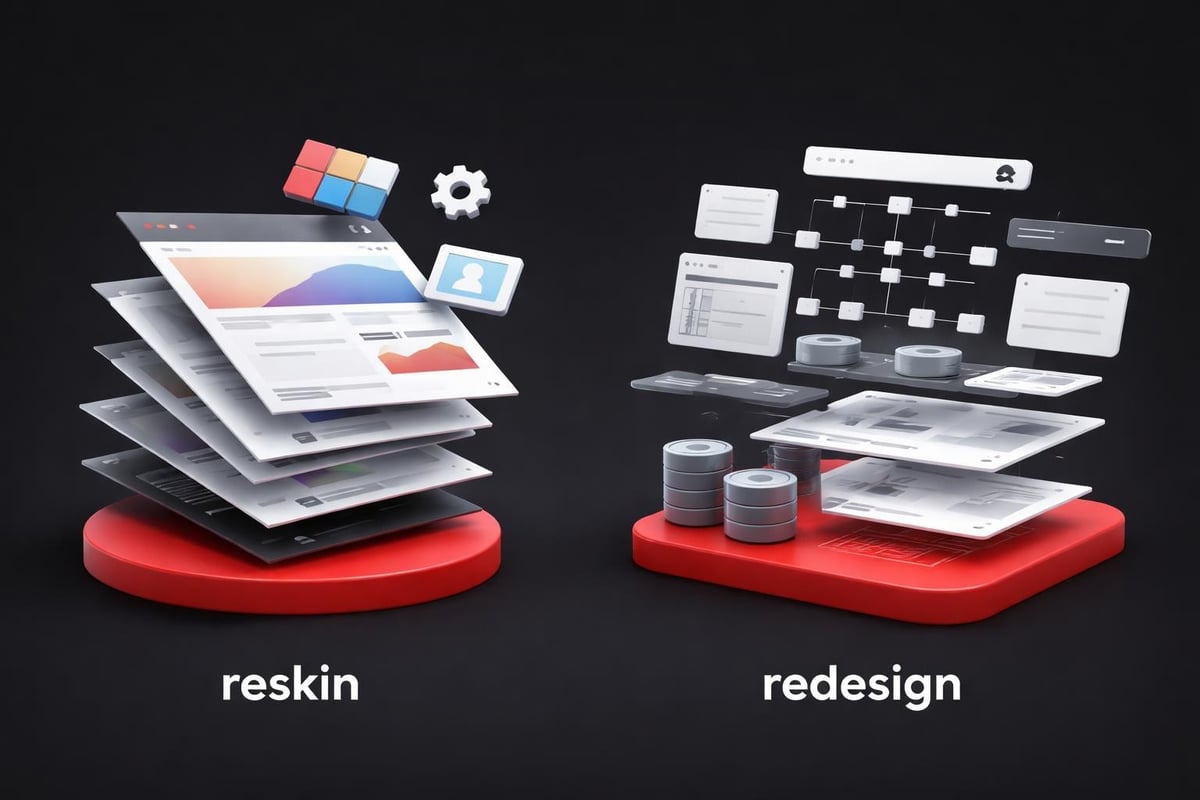
A website reskin replaces your site's visual presentation while keeping the underlying structure intact. Think of it as swapping the interior finishes in a building without touching the foundation or floor plan.
Your navigation stays. Your URL structure remains unchanged. Your CMS and technical stack continue running. What changes: typography, color systems, spacing, imagery, component styling, and interaction patterns.
What changes in a reskin:
- Color palette and brand application
- Typography and type scale
- Spacing and layout proportions
- Photography and illustration style
- Button styles and micro-interactions
- Component visual treatment
What stays the same:
- Information architecture
- Content hierarchy
- URL structure and SEO setup
- Backend systems and integrations
- Core user flows
- CMS and technical infrastructure
This distinction matters because it defines scope, timeline, and budget. A reskin typically takes 4-8 weeks instead of 4-6 months. It costs 30-50% of a full redesign. And it carries significantly less technical risk.
When a Reskin Makes More Strategic Sense Than a Redesign
Not every visual problem requires architectural surgery. Understanding when to reskin versus rebuild saves time and capital.
Your Brand Evolved But Your Structure Works
You rebranded six months ago. New logo, new colors, refined messaging. Your website still shows the old identity. The pages convert fine. Users navigate without friction. You just need the visual layer to catch up.
This is the clearest reskin scenario. Your site's bones are solid. Only the skin needs updating.
You're Preparing for a Funding Round
Investors look at your site within seconds of hearing your pitch. If it looks like a 2019 SaaS template, it signals lack of polish. But you can't afford to pause growth initiatives for a full redesign sprint.
A reskin gives you the professional presence investors expect without the operational disruption. We've seen this pattern repeatedly with Series A companies who need to look established before their round closes.
Your Analytics Show Good Performance Despite Dated Aesthetics
Check your conversion data. If your funnel performs well, your forms submit, and users complete key actions, your structure works. Visual staleness is perception, not function.
Redesigning a high-performing site introduces risk. You might accidentally break what's working. A reskin updates appearance while protecting performance.
Your Tech Stack Is Modern But Your Design Language Isn't
You built on a solid CMS. Your site loads fast. SEO is dialed in. The design just feels off-brand or outdated. This is pure visual debt, not technical debt.
| Scenario | Reskin | Full Redesign |
|---|---|---|
| Recent rebrand, functional site | ✓ Best choice | Overkill |
| Poor conversion, confusing nav | Only visual fix | ✓ Necessary |
| Outdated CMS, slow performance | Won't solve it | ✓ Required |
| Good metrics, dated aesthetics | ✓ Fast solution | Unnecessary risk |
| Major pivot in positioning | Depends on IA | ✓ Likely needed |
The Business Case: Speed and Capital Efficiency
Time to market determines competitive advantage. A full redesign takes 16-24 weeks from kickoff to launch. A website reskin ships in 4-8 weeks.
That difference compounds. While competitors rebuild their entire site, you've already updated your presence, run conversion tests, and iterated based on data. You've also preserved 12-16 weeks of engineering capacity for product development.
Capital allocation matters more at scale. A typical full redesign for a growth-stage startup runs $80K-$150K. A strategic reskin costs $25K-$60K. That $90K difference funds a quarter of paid acquisition, two product hires, or your entire content operation.
The ROI calculation is straightforward. If your current site converts at 3.2% and you believe a refresh will push that to 3.8%, you don't need to rebuild everything to capture that lift. You need to remove visual friction and align brand perception.
Most conversion problems stem from mismatched expectations (your site looks amateur but you're pitching enterprise clients) or dated patterns that signal distrust (2017 design conventions, stock photography, inconsistent branding). A reskin solves both.
The Reskin Execution Framework
Strategy comes before pixels. Most reskin projects fail because teams jump to visual exploration without documenting what's working and what needs to change.
Audit Before You Act
Run analytics on every major page and conversion point. Document which pages drive qualified traffic. Identify your highest-performing CTAs. Map user flows that actually convert.
Pull heatmaps and session recordings. See where users click, scroll, and drop off. This data separates aesthetic preferences from business priorities.
Interview internal stakeholders and recent customers. Ask what they expect to see when they land on your site. Compare those expectations to current reality. The gaps define your reskin scope.
Define Your Visual Strategy
Your reskin needs guard rails. Create a visual brief that specifies:
- Brand alignment goals: What does your new visual system need to communicate? Authority? Innovation? Accessibility?
- Reference sites: Not for copying, but for calibrating ambition and identifying effective patterns.
- Design principles: The 3-5 rules that guide every visual decision.
- Success metrics: How you'll measure whether the reskin worked (time on site, conversion rate, bounce rate, brand perception survey results).
This brief keeps the project focused. Without it, reskins drift into redesigns. Scope expands. Timeline doubles.

Execute Component by Component
Don't reskin page by page. That creates inconsistency and multiplies effort. Build from a component system.
Start with your foundational elements:
- Typography scale and application
- Color system (primary, secondary, neutral, semantic)
- Spacing and grid structure
- Button and form styles
- Card and container treatments
Once your base components are defined, apply them across pages systematically. This ensures consistency and speeds implementation.
For startups building on modern platforms, working in Framer makes this component-first approach natural. You define variants once and propagate changes instantly.
Test Before Full Rollout
A/B test your reskin on high-traffic pages before going site-wide. Run the new design on your homepage or primary landing page for two weeks. Compare conversion rates, engagement metrics, and qualitative feedback.
If performance dips, you haven't rebuilt your entire site. You can iterate quickly or roll back. This phased approach reduces risk dramatically compared to redesigning everything and launching all at once.
Common Reskin Mistakes That Kill ROI
Most reskin projects miss their goals because teams treat them as purely aesthetic exercises. The difference between a successful reskin and wasted budget comes down to discipline.
Scope Creep Into Full Redesign
You start reskinning. Then someone suggests reorganizing the navigation. Another stakeholder wants to rewrite all the messaging. Suddenly you're redesigning, but without proper research or strategy.
Set hard boundaries. If structural changes surface during the reskin, document them for a future phase. Don't let a focused refresh turn into an unplanned rebuild.
Ignoring Mobile-First Constraints
Your desktop reskin looks sharp. Mobile breaks. Typography is too large. Spacing doesn't scale. Components overlap.
Design for mobile first, then scale up. Most traffic comes from mobile devices. If your reskin doesn't work on a 375px viewport, it doesn't work.
Applying New Visuals to Broken Patterns
A reskin won't fix unclear value propositions or confusing user flows. If your messaging doesn't land, new colors won't help. If your form asks for 12 fields, a visual refresh won't increase completion rates.
Fix functional issues first. Then reskin.
Skipping Cross-Browser and Performance Testing
Your reskin looks perfect in Chrome on your MacBook. Then you check Safari on mobile. The custom fonts fail to load. The spacing breaks. Your 60fps animations stutter.
Test everywhere your users actually browse. Prioritize performance. A beautiful site that loads slowly converts worse than a plain site that loads instantly.
Real Reskin Scenarios and Outcomes
Theory means nothing without execution examples. Here's how different companies approached reskinning and what they learned.
B2B SaaS Platform: Pre-Series A Refresh
A developer tools company needed to look established for investor meetings. Their product worked. Their site looked like an MVP built by engineers (because it was).
They ran a four-week reskin focused entirely on visual credibility:
- Replaced developer-shot product screenshots with professionally designed interface captures
- Updated typography from system fonts to a modern, technical typeface
- Refined spacing to create breathing room and hierarchy
- Applied a sophisticated color system that signaled enterprise-readiness
Conversion rate on their demo request form increased 34% within three weeks. The visual upgrade reduced friction for enterprise buyers who expected polish.
Fintech Startup: Post-Rebrand Alignment
A payments company rebranded to target SMBs instead of enterprise. New name, new positioning, new visual identity. Their website still showed the old brand and corporate imagery.
The reskin took six weeks and covered:
- Complete color palette swap
- Typography update to friendlier, more accessible fonts
- Image replacement from corporate stock to authentic small business photography
- CTA language and button styling to match new brand voice
Traffic quality improved immediately. Bounce rate from paid ads dropped 28% because the landing experience finally matched ad messaging.
E-commerce Platform: Modernization Without Migration
An established e-commerce provider needed to compete visually with newer platforms. Their site worked, but design conventions were five years old. Understanding when to refresh versus rebuild helped them choose reskinning.
They updated visual presentation while keeping their complex pricing calculator and integration documentation intact. The reskin allowed them to look current without risking their technical foundation or SEO rankings.
| Company Type | Primary Goal | Timeline | Key Metric Improved |
|---|---|---|---|
| Developer Tools | Investor credibility | 4 weeks | +34% demo requests |
| Fintech Startup | Brand alignment | 6 weeks | -28% bounce rate |
| E-commerce Platform | Competitive appearance | 7 weeks | +22% trial signups |
Technical Considerations That Impact Reskin Feasibility
Not every site can be reskinned. Your technical foundation determines whether a reskin is viable or whether you need to rebuild.
CSS Architecture Matters
If your stylesheets are a mess of inline styles, !important declarations, and specificity wars, reskinning becomes expensive. You're fighting the existing code instead of working with it.
Modern sites built with component-based frameworks (React, Vue, Svelte) or design-first platforms reskin cleanly. Older WordPress sites with theme overrides stacked on plugin styles require more surgery.
Asset Management and Image Systems
A reskin often means replacing hundreds of images. If your images are hardcoded or scattered across poorly organized folders, this becomes manual labor.
Sites with proper asset management systems, CDN integration, and programmatic image handling reskin faster. You can swap assets systematically instead of hunting them down page by page.
Design System Maturity
Sites built from design systems reskin elegantly. Change your system variables. Regenerate your components. Ship the update.
Sites built page by page with one-off styling require exponentially more effort. Every component is unique. Every page needs individual attention.
This is why we build every project, including our Website Design offering, on systematic foundations from day one. It's not just easier to maintain. It's dramatically easier to evolve.
When to Skip the Reskin and Redesign Instead
Reskins solve visual problems. They don't solve strategic or structural problems.
Redesign instead if:
- Your information architecture confuses users and creates drop-off
- Conversion funnels are broken at a structural level
- Your tech stack can't support your current business model
- You've pivoted and need completely different page types
- Performance issues stem from backend architecture, not frontend bloat
- Mobile usability requires rethinking layouts, not just restyling them
Choosing between a reskin and full redesign requires honest assessment of where your problems actually live. If analytics show users can't find your pricing page, visual updates won't help. You need to restructure navigation.
If users abandon your checkout because it requires creating an account before purchase, that's a UX problem. Reskinning the checkout forms won't fix it.
Be brutally honest about root causes. A reskin is faster and cheaper, but only if it actually solves your problem.
Post-Reskin Optimization and Continuous Improvement
Launching your reskin isn't the end. It's the beginning of a data collection phase that informs what to improve next.
Monitor Performance Metrics Closely
Track the same metrics you baselined before the reskin. Compare week-over-week performance for at least four weeks to account for seasonality and traffic variance.
Watch for:
- Conversion rate changes across all major CTAs
- Time on page shifts that might indicate engagement improvements or confusion
- Scroll depth changes that show whether new visual hierarchy guides attention better
- Form completion rates that reveal if visual updates reduced friction or added confusion
Collect Qualitative Feedback
Numbers tell you what happened. Users tell you why. Run short surveys asking visitors about their impression of the site. Use tools like Hotjar to gather open-ended feedback.
The goal isn't to redesign based on every comment. It's to identify patterns that suggest opportunities for refinement.
Plan Your Next Iteration
Reskins aren't one-time events. Visual design trends evolve. Your brand matures. Your product offering expands.
Build a cadence for visual refresh. For high-growth startups, that might mean significant visual updates every 18-24 months and minor refinements quarterly.
This rhythm keeps your site feeling current without constant full redesigns. It also compounds improvements over time, which is how you build truly exceptional digital experiences.
Strategic Reskinning Creates Compounding Brand Value
Every interaction with your site either builds or erodes trust. An outdated visual presentation erodes trust even when everything else works perfectly.
Modern web design isn't about following trends for aesthetic reasons. It's about meeting user expectations that are set by the best sites they use daily. When your site looks dated, users assume your product is dated.
A strategic website reskin aligns your digital presence with your current market position without the cost and risk of rebuilding everything. It's the highest-leverage design investment most startups can make.
The companies that win aren't the ones constantly redesigning. They're the ones who ship updates quickly, measure results, and iterate based on data. Reskinning enables that velocity.
A website reskin gives you the visual presence your business deserves without the timeline and budget of a full redesign. It's about working smarter, not harder. If your site structure works but your brand has evolved, reskinning is the strategic move. Embark Studio™ helps investor-backed startups ship high-converting websites that grow with their business using systematic design and modern workflows. Ready to refresh your digital presence without disrupting momentum? Let's talk.
Get articles like this in your inbox
Practical design and growth insights for founders. No spam, unsubscribe anytime.


